Approaching data science from scratch often begins with an overwhelming tension between two extremes: theoretical mathematics or superficial software tutorials. Aspiring practitioners are frequently told to either begin by parsing formal measure theory or immediately start running high-level machine learning libraries without understanding the calculations running under the hood. However, formal occupational standards and foundational engineering literature point toward a third way: mastering core mathematical and algorithmic concepts by building them directly from first principles, alongside disciplined software engineering practices.
Whether navigating technical self-study, an intensive training programme, or an accredited degree route, developing data competence requires clarity on how foundational skills map to industry expectations. Deciding between technical branches—such as deciding whether you should study data science or data analysis—requires examining formal workplace requirements, curriculum structures, and training pathways.
The First-Principles Philosophy: Beyond Black-Box Libraries
The phrase “data science from scratch” became a defined pedagogical benchmark through Joel Grus’s text Data Science from Scratch: First Principles with Python. Grus identified a split in technical education: the purely theoretical “math path,” which focuses heavily on advanced proofs before ever handling real information, and the “tools path,” which teaches learners to import high-level packages without understanding what those tools actually calculate. Grus proposed a middle ground: acquiring a solid grasp of the mathematics by working through the mechanics behind common tools and implementing simplified algorithms directly from scratch in plain Python.
Building algorithms by hand demystifies how models arrive at predictions. When learners implement foundational models—such as linear regression, logistic regression, k-nearest neighbours, Naive Bayes, decision trees, and basic neural networks—using native Python data structures rather than pre-packaged imports, the underlying mechanics become transparent. This foundational understanding protects practitioners from misinterpreting model coefficients, failing to notice systemic errors, or struggling when standard libraries encounter unformatted real-world edge cases.
What Employers and Standards Require
Industry qualifications and government competency frameworks define data science as an interdisciplinary field extending far beyond simple algorithmic modeling. According to the UK occupational profile published by Prospects, data scientists are expected to extract, analyse, and interpret large volumes of information across industries such as retail, ecommerce, finance, healthcare, and government departments. The day-to-day requirements encompass working directly with stakeholders, building extraction pipelines, interrogating databases using languages like SQL, and presenting complex analytical outcomes in clear formats to non-technical teams.
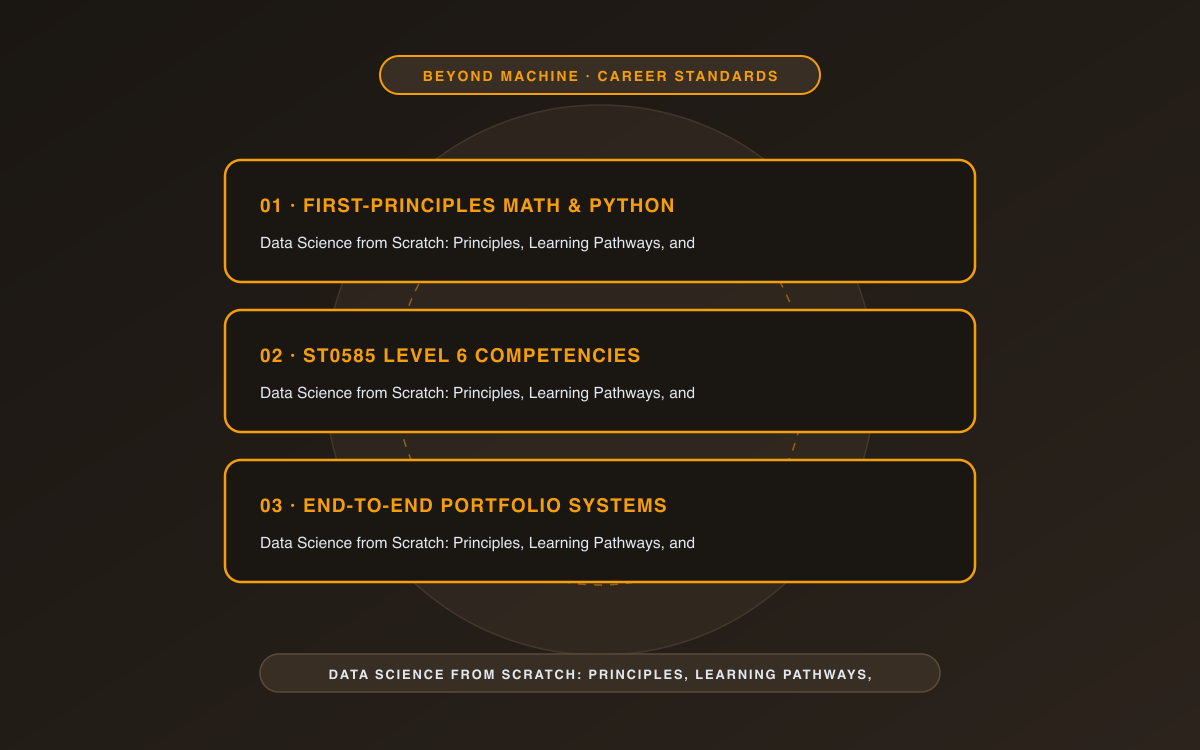
These applied expectations are codified systematically in the Skills England Data Scientist Level 6 Apprenticeship Standard (ST0585). The standard establishes that professional competence spans three interconnected domains:
- Data Engineering and Storage: Sourcing, profiling, pipelining, transforming, and governing diverse datasets across relational databases, data warehouses, NoSQL stores, and cloud or on-premise environments.
- Analytical Rigour and Modelling: Designing experiments, conducting hypothesis testing, separating correlation from causation, and implementing statistical, predictive, and machine learning models (including natural language processing and computer vision).
- Software Standards and Governance: Writing reproducible, production-grade code that adheres to version control, automated testing, data security, and international regulatory frameworks such as the General Data Protection Regulation (GDPR).
Comparing Learning Routes: Degrees, Bootcamps, and Self-Study
Those learning data science from scratch generally weigh formal university education, accelerated bootcamps, and self-directed study. Each route trades off time, direct financial investment, and curriculum structure. While bootcamps emphasize accelerated practical tooling, formal standards such as the Level 6 integrated degree standard set a high bar for end-to-end software engineering and statistical depth.
| Pathway | Typical Duration | Cost & Funding Models | Curriculum Breadth | Primary Trade-offs |
|---|---|---|---|---|
| Integrated Degree / Level 6 Apprenticeship | Typically 36 months (e.g., standard ST0585) | Government apprenticeship funding up to £19,000; employer funded | Deep theoretical math, software architecture, data engineering, and ethics | Long multi-year commitment; requires securing an approved employer sponsor |
| Data Science Bootcamps | Typically 3 to 9 months intensive | Self-funded tuition, commercial financing, or employer sponsorship | Practical tooling, Python libraries, SQL, basic machine learning workflows | Fast-paced; often relies on black-box tools with limited deep mathematics |
| Independent Self-Study | Self-paced (variable) | Minimal (books, open datasets, low-cost self-serve subscriptions) | Customisable: from foundational first principles to specialized tooling | Requires exceptional self-discipline; lacks external validation and code review |
The choice between these formats often shapes how candidates prepare for industry hiring hurdles. Anyone evaluating the employment outcomes of modern intensive programmes can explore whether they can learn data science and land a high-paying job based on realistic market compensation figures.
A First-Principles Curriculum Checklist
A structured data science curriculum built from scratch must cover both theoretical mechanics and production realities. Based on the ST0585 standard and foundational computing curricula, self-directed learners and course evaluators should ensure a curriculum addresses each of the following competencies:
- Mathematical Foundations: Linear algebra (vectors, dot products, matrix transformations), calculus for gradient updates, probability theory, and exploratory statistics (mean, variance, correlation).
- Core Programming: Native Python data structures (lists, tuples, dictionaries, sets), functional programming techniques, defensive error handling, and type-annotated function design.
- Data Ingestion and Engineering: Parsing raw text, structured JSON, web scraping, tabular datasets, building automated pipelines, and performing database operations via SQL.
- Algorithmic Modelling: Developing models from first principles—k-nearest neighbours, linear regression, logistic classification, decision trees, k-means clustering, and baseline neural networks.
- Software Engineering Disciplines: Modular software design, Git source control, reproducible workflows, automated unit testing, and benchmarking resource constraints.
- Governance and Ethics: Identifying algorithmic bias, managing data lineage, and ensuring operational compliance with privacy frameworks such as the GDPR.
Practical Implementation: Native Data Manipulation in Python
The first-principles methodology emphasizes using native language mechanics to clean, transform, and count data before relying on automated external frameworks. In Grus’s open-source curriculum code, basic data aggregation begins with clear algorithmic operations using native dictionaries and utility classes.
The following example demonstrates building a clean frequency counter directly from native collections, illustrating how foundational frequency tables operate without third-party frameworks:
from collections import defaultdict

# Sample input data: a stream of raw textual tokens
document = ["data", "science", "from", "scratch", "data", "science", "python"]

# Approach 1: Native dictionary iteration
word_counts = {}
for word in document:
    if word in word_counts:
        word_counts[word] += 1
    else:
        word_counts[word] = 1

# Approach 2: Using standard library collections
lookup = defaultdict(int)
for word in document:
    lookup[word] += 1

# Basic transformation and inspection
assert word_counts["data"] == 2
assert lookup["science"] == 2
assert lookup["scratch"] == 1
Understanding these direct transformations enables learners to appreciate what larger vectorization engines and distributed MapReduce systems execute when aggregating multi-terabyte data stores.
Portfolio Projects, Timeline, and Career Realities
Transitioning into a data science career requires balancing realistic timelines against verified employer compensation. As documented by Prospects, starting salaries for junior data scientists in the UK typically range from £25,000 to £30,000, rising to £40,000 with early experience. Mid-level practitioners with several years of proven execution earn between £40,000 and £60,000, while lead and chief data scientists earn £60,000 to over £100,000. Daily contract rates generally sit between £450 and £500.
Because the Digital Apprenticeship Standard ST0585 designates a typical 36-month timeline and a minimum of 883 compliance hours, learners should approach claims of mastering the discipline in a few short weeks with caution. For self-directed and bootcamp graduates, establishing credibility requires visible portfolio work. Rather than submitting generic tutorial walkthroughs, candidates stand out by participating in public competitive platforms such as Kaggle or Topcoder, publishing reproducible GitHub repositories featuring clean code and unit tests, and writing technical reports that connect analytical findings to business outcomes.
Furthermore, evaluating learning models requires understanding the shifts in remote and digital training environments, as outlined in analysis of the future of data science courses post-covid.
Evaluating a Provider: Critical Questions to Ask
Before committing capital or significant time to an external course or training provider, prospective students should rigorously vet the curriculum against professional standards. Essential questions include:
- How much code is written from first principles? Ensure the course does not rely solely on calling high-level library functions without teaching the mathematical and algorithmic foundations beneath them.
- What software engineering practices are enforced? Ask whether version control (Git), modular architecture, code quality, and testing standards are required components of project submissions.
- Is data engineering covered alongside modeling? High-performing data scientists spend substantial effort sourcing, cleaning, pipelining, and storing data across relational and non-relational databases.
- How are data privacy and ethics addressed? Verify that the curriculum covers real-world regulatory compliance, bias mitigation, and data governance frameworks.
- What formal credentials or pathway credits are awarded? Inquire whether the programme aligns with accredited bodies, such as the Alliance for Data Science Professionals or Science Council Registered Scientist benchmarks.
Frequently Asked Questions
What does it mean to learn data science from scratch?
Learning data science from scratch means starting from core mathematical principles (linear algebra, probability, and statistics) and foundational programming concepts rather than relying exclusively on pre-built high-level machine learning libraries. It involves understanding the math, data structures, and algorithms by implementing them directly.
What programming language should I begin with?
Python is the predominant language taught in foundational data science literature and recognized across occupational training standards, alongside database languages such as SQL. Other languages commonly utilized in industry include R, Java, and C.
Do I need a university degree to work as a data scientist?
Prospects reports that employers typically look for candidates with a degree in computer science, mathematics, statistics, engineering, or a related science discipline. However, candidates with backgrounds in business, economics, psychology, or health are also considered if they possess strong mathematical aptitude and coding capabilities. In addition, Level 6 integrated degree apprenticeships offer a structured route to earn a degree while working directly with an employer.
References
- Data Science From Scratch: First Principles with Python | Joel Grus
- Data scientist (integrated degree) | Skills England Standard ST0585
- Data scientist job profile | Prospects.ac.uk
Primary Technical Specification: Reproducible scientific computing and production pipeline implementations in UK data science programmes benchmark against the official Python 3 Tutorial and Standard Library Reference (Python Software Foundation).
1-on-1 AI & Data Science Mentorship
Accelerate your career with personal coaching from Dr. Stylianos Kampakis. Tailored portfolio reviews, interview prep, and direct industry placement.
Atlas Paragon Small Business Operations & Security Guides
Independent, evidence-backed checklists for small-business software selection, accounting workflows, and security.