
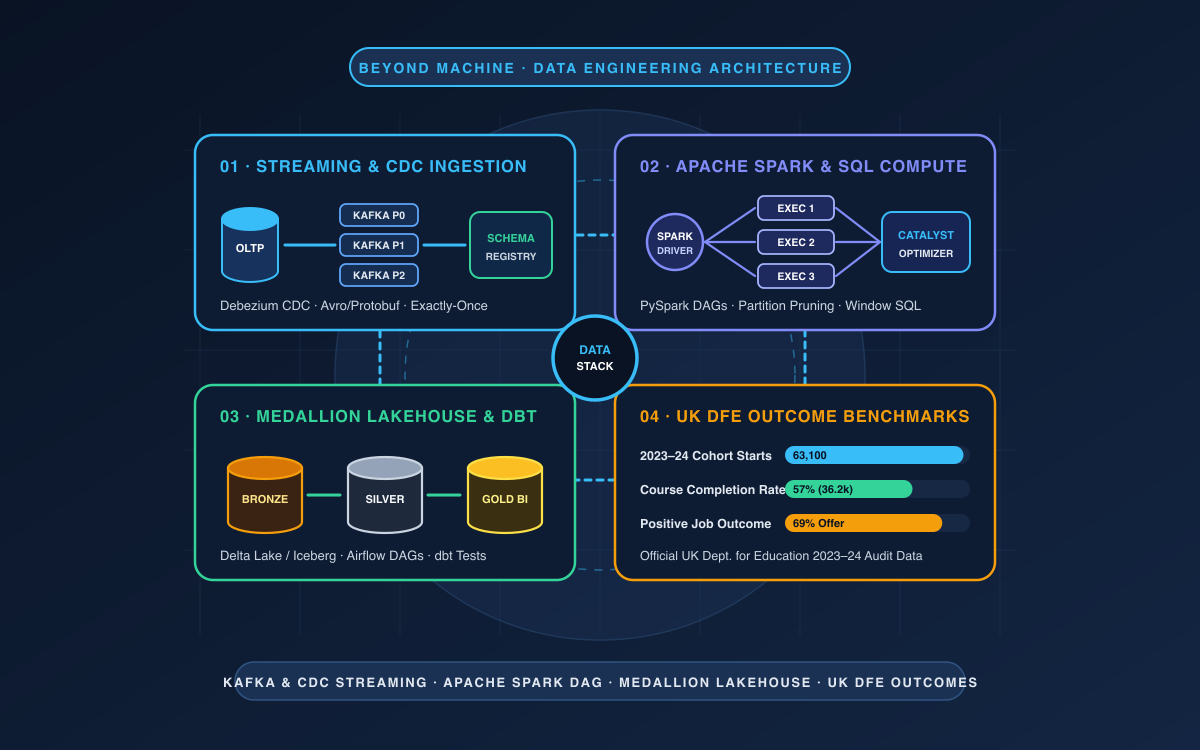
Understanding the Data Engineering Bootcamp Model
A data engineering bootcamp is an intensive, skills-focused training pathway designed to prepare participants for building and maintaining data systems. Unlike open-ended academic qualifications, bootcamps are condensed into structured, practical modules that align with direct industry requirements. In government-backed frameworks such as the UK Department for Education (DfE) initiative, these courses run as flexible, employer-led training programmes lasting up to 16 weeks, offering adult learners a route to upskill or transition into technical roles.
While software engineering courses traditionally concentrate on web frameworks, user interfaces, or general application logic, data engineering programmes focus specifically on ingestion, storage, transformation, and pipeline maintenance. This operational focus separates data infrastructure work from what data scientists, ML engineers, and AI practitioners do in day-to-day analytical tasks. Prospective entrants evaluate bootcamps to determine whether a short-form, accelerated course delivers the architectural knowledge, systems-level scripting capabilities, and commercial viability required to secure employment as a data engineer.
Defining the Data Engineer Role: Government and Industry Standards
To assess what a training curriculum must cover, candidates can examine established competency architectures. The Government Digital and Data Profession Capability Framework defines a data engineer as a professional who develops and constructs data products and services, integrating them into production systems and business processes. Within this framework, entry-level practitioners operate under the guidance of senior technical staff while executing core systems workflows.
At the baseline data engineer grade, the capability framework establishes specific day-to-day responsibilities, including:
- Implementing data flows that connect operational platforms, business intelligence (BI) systems, and analytical data stores.
- Writing extract, transform, load (ETL) scripts and optimizing pipelines for reliable execution.
- Documenting source-to-target mappings and reverse-engineering data models from existing platforms.
- Supporting the build and ongoing maintenance of real-time data streaming architectures.
- Re-engineering manual or legacy data flows to establish scalable, repeatable, and automated pipelines.
- Developing reusable business intelligence reports and curating accessible data repositories for downstream analysts.
The standard establishes four defined progression levels: entry-level Data Engineer, Senior Data Engineer, Lead Data Engineer, and Head of Data Engineering. Progression requires moving from baseline awareness to working and practitioner competence across domains such as programming and build, data integration design, metadata management, and data compliance.
Core Technical Competencies: Data Modelling, Batch ETL, and Streaming Systems
Production data pipelines rely heavily on robust data modelling and programming discipline. The Government Digital and Data standard mandates a “Working” skill level in data modelling, requiring engineers to produce, maintain, and update schema models tailored to specific organisational requirements. This entails applying relational data structures, dimensional designs, and normalization techniques to avoid redundancy and maintain transactional integrity across operational databases.
Beyond modelling, engineers must understand both batch and streaming architectures. Batch processing involves scheduling extraction and transformation jobs across discrete historical windows using SQL and automated scripts. In contrast, data streaming demands architecture capable of processing continuous event queues in real time. The official role framework expects data engineers to design repeatable data development processes, integrate automated testing into deployment workflows, and handle security classification and compliance policies at every pipeline stage.
Comparing Bootcamps, Degrees, and Apprenticeship Pathways
The compressed duration of a bootcamp contrasts sharply with traditional academic computer science and data science degree programmes. Formal curriculum guidelines published by the ACM Data Science Task Force in their report on Computing Competencies for Undergraduate Data Science Curricula define eleven comprehensive computing Knowledge Areas (KAs). These include Big Data Systems (BDS), Data Acquisition, Management, and Governance (DG), Computing and Computer Fundamentals (CCF), Software Development and Maintenance (SDM), and Programming, Data Structures, and Algorithms (PDA).
Academic reviews documented in the Global AI and Data Science Education Landscape analysis note that undergraduate frameworks—such as the Park City Math Institute (PCMI) guidelines and the National Academies Data Science for Undergraduates study—integrate deep mathematical foundations, linear algebra, probability theory, and discrete structures alongside computational training. While broader academic curricula examine algorithmic foundations and the architectural role of machine learning, data engineering bootcamps concentrate specifically on practical systems execution: writing pipeline scripts, managing metadata repositories, and executing queries against production databases.
Apprenticeships offer a third pathway, combining paid full-time workplace employment with off-the-job training. Bootcamps provide the fastest route of the three, but their shorter duration leaves little room for theoretical detours, requiring learners to assimilate practical tools and coding standards rapidly within 12 to 16 weeks.
Official Completion and Employment Outcomes: England Skills Bootcamps Data
Prospective students frequently evaluate bootcamps based on promotional placement rates. Transparent, population-level evidence is available in official government reporting. The Department for Education and Department for Work and Pensions published comprehensive statistics in the Skills bootcamps starts, completions and outcomes for financial year 2023-24, providing an empirical benchmark for short-cycle technical training.
Across all England Skills Bootcamps in 2023–24, there were 60,410 starts, resulting in 43,020 completions (a 71% completion rate) and 28,360 positive outcomes (a 47% outcome rate based on starts). However, performance varied widely across subject sectors. While sectors like Construction (83% completion, 69% outcome) and Preparation for Life and Work (93% completion, 63% outcome) recorded high conversion rates, technical computing fields faced stiffer challenges. The Digital sector recorded a 65% completion rate and an outcome rate of 31% relative to starts. Courses categorised under Science and Mathematics—representing Digital Skills Bootcamps with a specific emphasis on data—achieved a 71% completion rate but an outcome rate of only 27%.
The official statistics reveal significant differences based on learner background and regional delivery:
- Employer Co-funding: Learners whose participation was co-funded by an employer achieved a completion rate 16 percentage points higher and an outcome rate 40 percentage points higher than independent, self-funded or fully state-funded learners.
- Prior Employment Status: Learners who were already self-employed achieved a 78% completion rate and a 63% outcome rate. Conversely, learners not in paid employment at the start of training (comprising 39% of all starts) saw completion rates drop to 68% and positive outcomes fall to 35%.
- Regional Differences: Regional delivery generated substantial variance. The North East recorded the highest performance (80% completion, 60% outcome rate), whereas London recorded the lowest regional rates across England (64% completion, 33% outcome rate).
- Demographics: White learners recorded a 76% completion rate and 57% outcome rate, compared to 60% completion and 27% outcome rates for Black learners. Men achieved higher overall completion (72%) and outcome (50%) rates than women (69% and 38%), primarily due to heavier male enrollment in trades like construction, though women slightly outperformed men within the Digital sector itself.
Comparative Performance Across Training Sectors
The table below summarizes official delivery figures across major subject areas in the 2023–24 national cohort, contextualizing the relative performance of data and digital programmes against broader skills bootcamps.
| Sector Subject Area | Completion Rate (%) | Outcome Rate (% of Starts) | Primary Target Focus |
|---|---|---|---|
| Digital | 65% | 31% | Software development, IT, cybersecurity, digital workflows |
| Science and Mathematics (Data emphasis) | 71% | 27% | Data engineering, data analysis, quantitative pipelines |
| Construction | 83% | 69% | On-site trades, building infrastructure, site supervision |
| Preparation for Life and Work | 93% | 63% | Foundational employment preparation, workplace core skills |
| Health | 86% | Not reported in headline release | Healthcare support, medical administrative workflows |
| Retail and Commercial (including HGV) | 70% | Not reported in headline release | Warehousing, distribution, commercial transport |
Actionable Evaluation Checklist: Questions to Ask Providers Before Enrolling
Given the rigorous demands of technical engineering roles and the measurable variance in outcome rates, prospective students must scrutinize provider claims carefully. According to the Skills bootcamps starts, completions and outcomes methodology, regulatory bodies define positive outcomes through verifiable milestones, including newly obtained employment, apprenticeships, increased employer responsibilities, or authenticated commercial self-employment contracts.
Before committing time or capital to a data engineering bootcamp, candidates should ask providers the following practical, verification-oriented questions:
- How do you define and verify a “successful outcome”? Confirm whether advertised placement figures refer strictly to full-time data engineering positions or include unrelated lower-tier roles, internships, or temporary work.
- Is an employer interview guaranteed upon completion? Under official UK Skills Bootcamp guidelines, independent learners must be provided an offer of a genuine job interview with an employer upon completing training and assessments. Ask which partner employers conduct these interviews.
- What proportion of the curriculum is dedicated to production pipelines versus basic reporting? Review whether the syllabus focuses on relational modelling, streaming queues, and ETL automation, or if it leans excessively on basic business intelligence dashboards and exploratory data manipulation.
- What prior technical prerequisites are enforced? The data indicates that prior educational attainment impacts completion. Verify whether incoming cohorts require baseline programming experience or if absolute beginners are accepted without screening.
- How is practical competency evaluated? Determine whether assessments require deploying automated code and source-to-target integration mappings, or if they rely on multiple-choice conceptual quizzes.
- What support exists for non-co-funded independent learners? Given that independent learners see lower average outcome rates than candidates co-sponsored by current employers, ask what dedicated technical mentorship and career transitions are provided to jobseekers.
Frequently Asked Questions
How long does a data engineering bootcamp typically run?
Most intensive bootcamps run on flexible schedules spanning up to 16 weeks for full-time or accelerated part-time cohorts. This window aligns with national standards for adult technical retraining programmes, balancing foundational instruction with portfolio pipeline builds.
What technical languages and concepts are mandatory in a data engineering syllabus?
According to the Government Digital and Data Profession Capability Framework, data engineers require working competence in programming, data development processes, and data integration. Syllabi should emphasize SQL, database management, pipeline scripting, source-to-target mapping, ETL development, and exposure to data streaming systems.
How realistic are employment claims from technical bootcamps?
Official UK government statistics for the 2023–24 financial year demonstrate that while Skills Bootcamps achieve an average 71% completion rate, positive outcomes for digital and data-focused cohorts range between 27% and 31% of starts. Prospective students should use these published benchmarks rather than self-reported marketing figures when evaluating expected returns on investment.
References
- Release home – Skills bootcamps starts, completions and outcomes – Explore education statistics – GOV.UK
- Skills bootcamps starts, completions and outcomes: methodology – Explore education statistics – GOV.UK
- Data engineer – Government Digital and Data Profession Capability Framework
- ACM Data Science Task Force
1-on-1 AI & Data Science Mentorship
Accelerate your career with personal coaching from Dr. Stylianos Kampakis. Tailored portfolio reviews, interview prep, and direct industry placement.
1-on-1 VIP Mentorship & AI Bootcamp Application
Personalized career acceleration and portfolio review directly with Dr. Stylianos Kampakis.