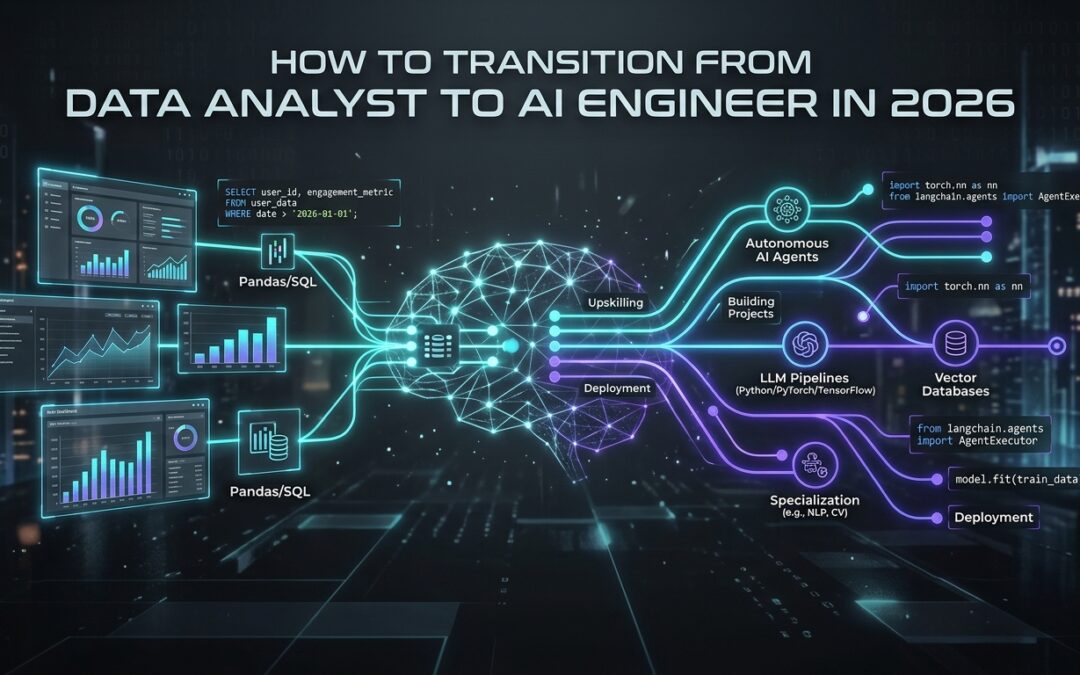
The global tech ecosystem has reached a definitive turning point. Software development teams are no longer tasked simply with implementing deterministic CRUD APIs, relational database schemas, or front-end components. Instead, organizations are demanding intelligent systems capable of natural language reasoning, autonomous decision-making, and dynamic data synthesis.
For mid-level and senior software engineers, this represents the single greatest career opportunity of the decade. Yet, a common misconception prevents many talented developers from making the leap: the belief that transitioning to AI requires a PhD in pure mathematics or years of academic training in deep learning tensor calculus. In production, AI engineering is fundamentally an engineering discipline, requiring the rigorous application of systems architecture, evaluation harnesses, and reliability engineering to non-deterministic foundation models.
In this comprehensive roadmap, we outline the exact architectural frameworks, tooling evolutions, and career milestones required to successfully transition from software engineer to production AI engineer in 2026.
Architectural Comparison: Software Engineering vs. AI Engineering
To successfully navigate this career pivot, you must understand the operational trade-offs and architectural shifts between traditional software development and AI engineering:
| Dimension | Traditional Software Engineering | Production AI Engineering |
|---|---|---|
| System Nature | Deterministic: Given input X, output is always guaranteed to be Y. |
Probabilistic: Outputs depend on sampling temperatures, context embeddings, and model weights. |
| Core Tech Stack | Java, Go, TypeScript, PostgreSQL, Redis, distributed microservices, React. | Python, PyTorch, LangGraph, vLLM, Vector DBs (Qdrant, pgvector), Pydantic. |
| Testing Strategy | Unit tests, regression integration tests, deterministic mock asserts. | Synthetic test eval sets, LLM-as-a-Judge, semantic similarity metrics, RAG triad assertions. |
| Failure Modes | Null pointer exceptions, race conditions, stack traces, 500 errors. | Silent hallucinations, prompt injection, tool calling loops, context window degradation. |
| Latency & Cost Focus | CPU utilization, database connection pools, memory leak profiling. | Time-to-First-Token (TTFT), tokens-per-second, GPU VRAM caching, inference routing cost. |
The 4-Pillar Roadmap: From Code Author to AI System Architect
To systematically build production AI capability without getting bogged down in low-level theoretical weeds, software developers must follow a disciplined, four-stage engineering sequence. By leveraging your existing engineering strengths\u2014such as object-oriented design, distributed systems, clean architecture, and API protocols\u2014you can master the AI stack progressively from numerical computing to agentic swarms and low-latency inference.
Pillar 1: Pythonic Foundations & Tensor Data Manipulation
While polyglot engineering is valuable, Python remains the universal runtime of modern artificial intelligence. Software engineers coming from Java, C#, or TypeScript must become intimately familiar with Python’s vectorized computing paradigms:
- NumPy and Vector Mathematics: Master array broadcasting, dot products, matrix transposition, and cosine similarity calculations without relying on third-party abstractions.
- Pydantic v2: Modern AI engineering relies heavily on structured output generation. Using Pydantic models with OpenAI or Anthropic tool schemas ensures strict type-safety across agent boundaries.
- Asynchronous Python (asyncio): Production AI services frequently juggle concurrent streaming responses and multi-source tool retrievals. High-performance inference servers require deep knowledge of async event loops.
Pillar 2: The Modern Cognitive Stack: RAG, Embeddings & Vector Databases
Retrieval-Augmented Generation (RAG) is the foundational architecture of enterprise AI. Rather than retraining or fine-tuning multi-billion parameter models, RAG injects proprietary enterprise context into the prompt at runtime:
- Chunking Strategies: Move beyond naive fixed-character chunking. Implement semantic boundary chunking, parent-document retrieval, and recursive character splitting to preserve context integrity.
- Hybrid Search: Combine dense vector embeddings (cosine distance) with sparse BM25 keyword matching and cross-encoder re-ranking (e.g., Cohere Rerank or BGE Reranker) to maximize recall precision.
- Vector Store Operations: Understand index architectures (HNSW vs. IVFFlat) inside production stores like Qdrant, Milvus, or PostgreSQL with the
pgvectorextension.
Pillar 3: Autonomous Agents & Tool Calling Loops
The progression from simple question-answering systems to autonomous agents requires orchestrating models that can reason, take actions, and self-correct across multi-turn loops. As detailed in our companion tutorial on Building Your First Autonomous AI Agent with Python, production agents require deterministic guardrails:
- ReAct Framework (Reasoning + Acting): Structuring model thoughts and action invocations into cyclical loops with explicit exit criteria.
- State Graph Architectures: Utilizing tools like LangGraph to model agent workflows as cyclical state graphs with human-in-the-loop checkpoints and conditional branching.
- Model Context Protocol (MCP): Standardizing how LLMs interface with local and remote tools, filesystem sandboxes, and enterprise databases.
Pillar 4: Production MLOps, Containerization & Serving
Building a proof-of-concept in a Jupyter notebook is fundamentally different from serving thousands of concurrent users. As highlighted in our engineering guide on Containerizing and Deploying ML Models with Docker, shipping AI models requires rigorous container hygiene:
- Multi-Stage Docker Builds: Separating build-time compiler dependencies from lean runtime execution environments to minimize image footprints and eliminate CVE vulnerabilities.
- High-Throughput Serving Engines: Transitioning from generic WSGI servers to specialized inference runtimes like vLLM (with PagedAttention) and Ollama for on-premise deployments.
- Streaming Telemetry: Instrumenting OpenTelemetry spans for token latency, time-to-first-token (TTFT), and semantic drift.
Common Implementation Pitfalls & How Industry Leaders Avoid Them
When transitioning from traditional engineering to AI, developers frequently encounter three critical failure patterns:
- Premature Fine-Tuning: Developers often assume they need to fine-tune an open-weight model with LoRA or QLoRA immediately. In reality, 95% of enterprise use cases are better served by few-shot prompt engineering, structured schemas, and robust RAG pipelines. Fine-tuning introduces severe operational overhead and model drift.
- The “Evaluation Gap”: In software engineering, code passes or fails unit tests deterministically. In AI, teams often rely on manual “vibe checks.” Production AI engineers build automated synthetic evaluation datasets using frameworks like DeepEval or Ragas to quantify faithfulness, answer relevance, and hallucination rates continuously.
- Ignoring Token Economics & Rate Limits: Designing architectures that blindly send thousands of tokens on every request leads to catastrophic cloud bills and sudden HTTP 429 throttling. Seasoned engineers implement prompt compression, semantic caching (via Redis or GPTCache), and tiered model routing (directing simple queries to lightweight models and complex reasoning to flagship models).
Curated Career Acceleration Resources
To accelerate your transition from software engineer to AI engineer with hands-on, production-tested curricula, explore our free engineering courses and VIP mentorship opportunities below. Each flagship curriculum is engineered around real-world problem sets, verifiable GitHub deliverables, and direct industry relevance:
-
Master function calling, ReAct patterns, LangChain, and production agent sandboxing with hands-on Python exercises and real-world tools.
-
Learn multi-stage Docker builds, FastAPI serving, low-latency endpoints, and production container hardening for enterprise MLOps.
-
The complete modern cognitive stack for automated EDA, natural language SQL, and interactive portfolio dashboards deployed with Streamlit.
1-on-1 VIP Mentorship & AI Bootcamp Application
Personalized career acceleration and portfolio review directly with Dr. Stylianos Kampakis.
Academic Foundations & System Literature
For peer-reviewed literature on deep learning scaling laws and transformer architectures, refer to the seminal research published in the arXiv Research Repository. Foundational epistemological and architectural paradigms are also comprehensively cataloged in the Wikipedia Systems Architecture Compendium.
1-on-1 AI & Data Science Mentorship
Accelerate your career with personal coaching from Dr. Stylianos Kampakis. Tailored portfolio reviews, interview prep, and direct industry placement.