Selecting the right bootcamp in data science requires evaluating more than marketing brochures and promotional job-placement percentages. Because technical bootcamps do not participate in federal financial aid programs, prospective students carry the full financial risk of their enrollment. Making an informed choice requires a methodical assessment of three core areas: curriculum architecture, hands-on career coaching support, and independently verified employment data.
Curriculum Architecture: Core Data Science vs. Analytics Pathways
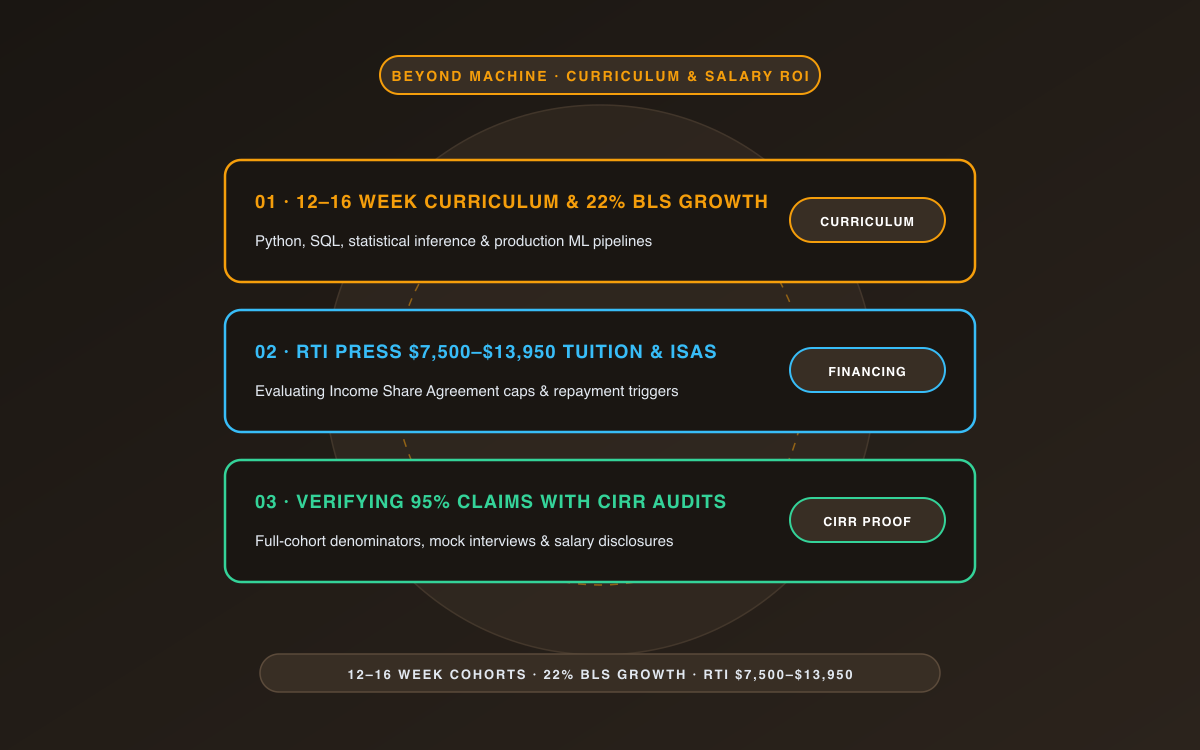
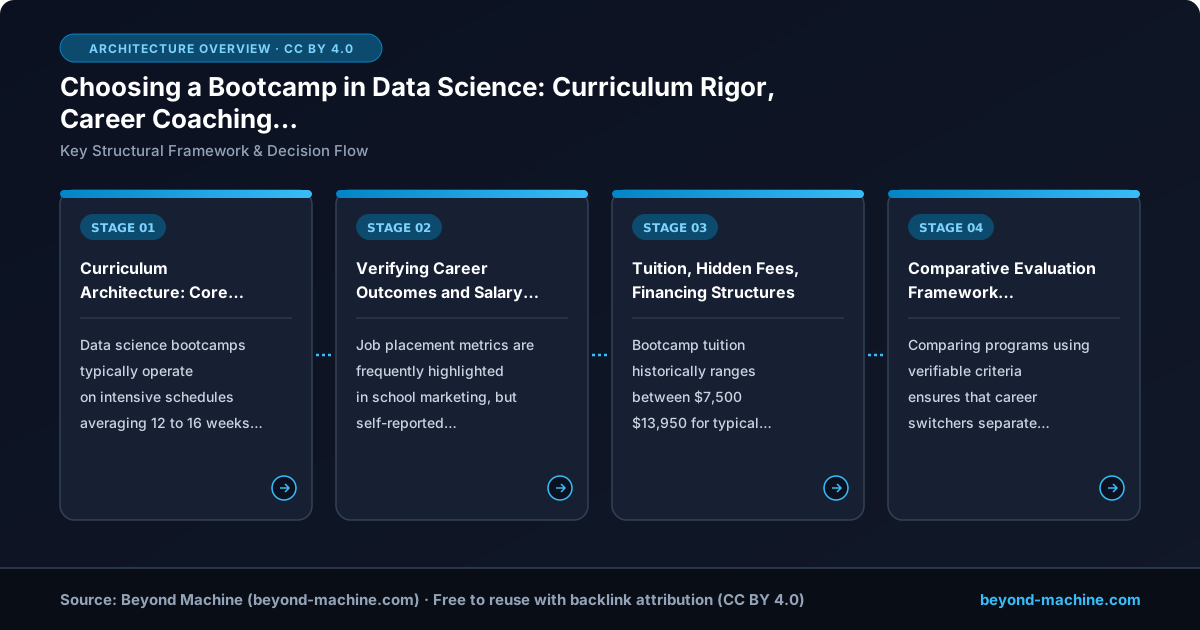
Data science bootcamps typically operate on intensive schedules averaging 12 to 16 weeks for full-time cohorts, though part-time and self-paced tracks extend longer. The primary determinant of educational value is whether the syllabus focuses on production-grade software development and statistical modeling, or if it resembles an introductory data analytic bootcamp centered around business intelligence reporting.
Rigorous data science training emphasizes programming languages such as Python, core algorithmic concepts, and database architecture alongside exploratory data analysis. Students preparing for modern engineering demands often bridge analytics with infrastructure; evaluating whether a program covers pipeline orchestration or production deployment is critical. Those looking at end-to-end technical transitions often cross-reference curriculum topics with specialized pathways, such as moving from a data analyst to AI engineer or exploring data engineering curricula and official benchmarks.
Prospective students should verify whether a program includes foundational programming, version control, and data pipeline fundamentals before committing. Programs that skip core engineering concepts often prepare graduates only for basic analytical tasks rather than competitive data science and engineering roles.
Verifying Career Outcomes and Salary Claims
Job placement metrics are frequently highlighted in school marketing, but self-reported numbers often obscure student dropouts, selective cohort sampling, or non-technical placements. To counter misleading claims, independent verification frameworks evaluate programs against standardized metrics.
The Council on Integrity in Results Reporting (CIRR) provides an auditing framework that holds participating bootcamps accountable across six core standards:
- Truth in Advertising: Strict guidelines prohibiting misleading marketing claims regarding student outcomes.
- Early Intent Tracking: Documenting student career goals on day one to prevent retrospective exclusion of unplaced graduates.
- Complete Enrollment Data: Accounting for every enrolled student from orientation through graduation.
- Comprehensive Job Tracking: Monitoring graduate employment with detailed placement breakdowns, job titles, and base salary figures.
- Regular Reporting: Mandating the publication of standardized outcomes reports annually.
- Independent Verification: Requiring annual third-party audits to verify all submitted data.
According to data reviewed by ComputerScience.org, demand across core tech occupations shows robust long-term momentum, with the U.S. Bureau of Labor Statistics (BLS) projecting a 22% growth rate for data scientists and software developers. However, landing these roles depends on transparent outcomes. Standardized reports disclose not just aggregate placement rates, but also the critical time-to-employment window (often averaging around three to six months post-graduation) and verified median annual base salaries for in-field employment.
Tuition, Hidden Fees, and Financing Structures
Bootcamp tuition historically ranges between $7,500 and $13,950 for typical offerings, according to research from RTI Press, though total costs depend on delivery method, cohort length, and institution. When evaluating program affordability, students must also account for secondary expenditures that are rarely bundled into base tuition:
- Application and seat deposit fees
- Specialized lab, cloud compute, or software licensing fees
- Required hardware upgrades or textbooks
- Prerequisite preparatory courses designed to close technical knowledge gaps before day one
Payment options vary significantly across institutions. Students can typically choose between upfront tuition payments, fixed monthly installments, private education loans, or deferred payment structures such as Income Share Agreements (ISAs). Under an ISA or deferred model, students delay tuition payments until they secure a qualifying role. However, terms vary widely regarding repayment caps and minimum salary thresholds, making direct contract scrutiny essential.
Additionally, the structure of remote versus on-campus delivery influences the total investment. Prospective learners evaluating how course formats have shifted since global shifts to remote instruction can read more about the future of data science courses post-covid.
Comparative Evaluation Framework for Bootcamp Selection
Comparing programs using verifiable criteria ensures that career switchers separate marketing assertions from verified educational results.
| Evaluation Pillar | Standard Marketing Claims | Verified Auditing Standard (CIRR-Aligned) |
|---|---|---|
| Reporting Transparency | Internal placement surveys; unverified percentage claims (e.g., "95% hired"). | Standardized annual reporting verified by independent third-party auditors. |
| Cohort Tracking | Excludes dropouts, non-responders, or students taking non-tech jobs. | Full enrollment tracking from day one; documented career intent recorded at orientation. |
| Salary Metrics | Aggregated averages often inflated by pre-existing technical compensation. | Median annual base salaries specifically tied to in-field placements. |
| Time to Employment | Vague or undefined post-graduation tracking windows. | Fixed outcome milestones documenting placement velocity within standardized timeframes. |
| Tuition Models | Promised job guarantees with opaque qualification clauses. | Transparent schedules covering full tuition, hardware needs, and clear deferred terms. |
Assessing Career Services and Interview Preparation
A data science curriculum must be supported by structured career development to translate technical exercises into hireable qualifications. Career services should not simply consist of resume formatting templates. Prospective students should examine whether career coaches offer targeted technical interview preparation, behavioral interview strategies, and dedicated guidance on presenting portfolio repositories.
Effective coaching teams provide structured timeline tracking, active employer network outreach, and realistic compensation negotiation strategies. When programs transparently report both median starting salaries and the time required for graduates to secure positions, students can calibrate their post-graduation financial runway with precision.
Frequently Asked Questions
What is CIRR and why does it matter for data science bootcamps?
The Council on Integrity in Results Reporting (CIRR) is an independent non-profit organization that establishes standardized outcome reporting for accelerated learning programs. Member schools must track all enrolled students from day one, publish standardized annual reports, and submit their placement and salary metrics to independent annual third-party audits. This eliminates selective reporting and gives students reliable data on graduation rates and median salaries.
How much do tech bootcamps typically cost?
Typical bootcamp tuition historically ranges from $7,500 to $13,950, based on benchmark research from RTI Press. Beyond tuition, learners must account for computer equipment, software, application fees, and potential preparatory coursework.
Can I use federal financial aid to fund a data science bootcamp?
Coding and data science bootcamps do not currently qualify for federal Title IV financial aid programs. Students typically finance tuition through direct upfront payments, monthly installment plans, private student loans, or deferred payment arrangements such as Income Share Agreements (ISAs).
1-on-1 AI & Data Science Mentorship
Accelerate your career with personal coaching from Dr. Stylianos Kampakis. Tailored portfolio reviews, interview prep, and direct industry placement.
Sponsored Editorial Publishing & Tech Media Placement
Get your technical product or case study published on The Data Scientist with domain authority backlinks.