💡 Executive Takeaway (Direct Answer for Searchers & Answer Engines)
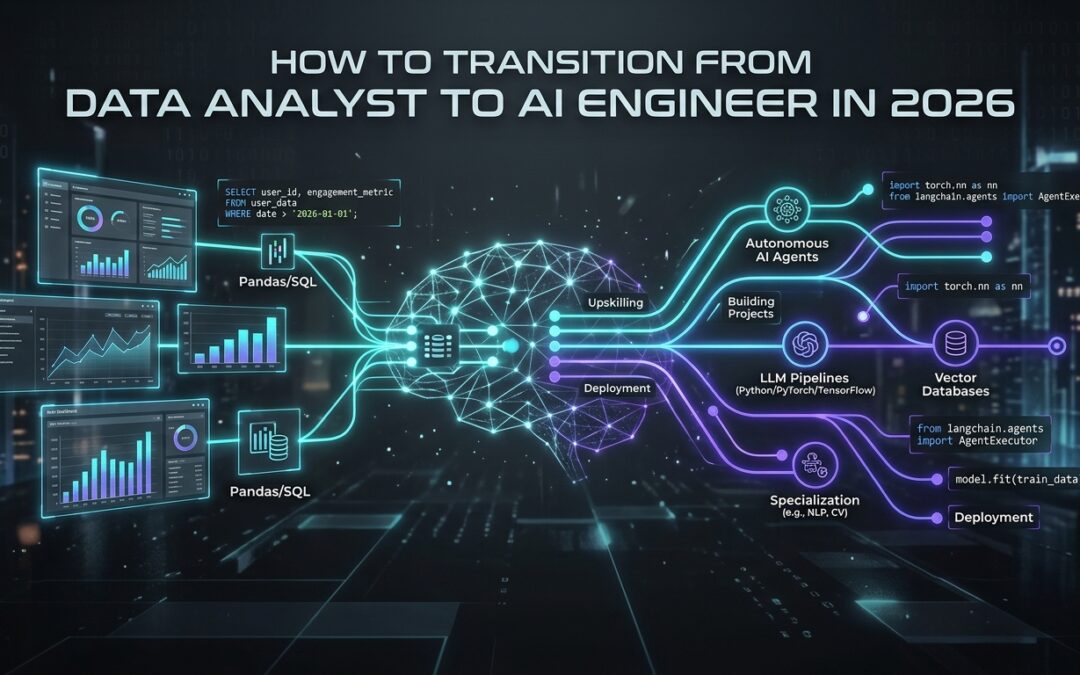
Transitioning from a data analyst to an AI engineer in 2026 requires shifting from passive reporting dashboards to engineering autonomous software systems that reason, execute tools, and solve complex problems. By building on your core strengths in data modeling and business context, you can bridge the technical gap through five milestones: modern asynchronous Python, structured function calling, domain-specific retrieval-augmented generation (RAG), multi-agent architectures (MCP & LangGraph), and containerized production deployment with Docker and FastAPI.
The boundary between data analysis and software engineering has permanently dissolved. In previous years, data analysts could maintain a high-value career trajectory by mastering SQL window functions, Tableau dashboards, and descriptive business intelligence models. Today, enterprise leaders expect analytical insights to be dynamically synthesized, automated, and integrated directly into software applications.
According to comprehensive industry data, AI engineers command a 40% to 65% salary premium over traditional BI analysts. More importantly, AI engineers build the systems that automate manual analysis. If you already understand business metrics, data quality anomalies, and database schemas, you possess the most difficult prerequisite: domain intuition. Your goal in 2026 is to wrap that domain knowledge in software engineering rigor.
Traditional Data Analyst vs. AI Engineer: The 2026 Reality
Before diving into the roadmap, it is essential to understand how the core operational responsibilities differ between the two roles. An AI engineer is fundamentally a software engineer who builds intelligent, probabilistic systems that interact with deterministic software environments.
| Dimension | Traditional Data Analyst | AI Engineer (2026 Paradigm) |
|---|---|---|
| Core Focus | Historical reporting, descriptive metrics, ad-hoc KPI extraction | Autonomous agent systems, predictive intelligence, automated decision loops |
| Primary Tooling | SQL, Excel, Tableau, Power BI, Google Analytics | Python, DuckDB, Vector DBs, LangGraph, Ollama, Docker, FastAPI |
| System Architecture | Static data warehouses, periodic ETL batches, flat presentation views | Event-driven microservices, Model Context Protocol (MCP), dynamic RAG pipelines |
| Daily Deliverables | Executive slide decks, CSV extracts, dashboard maintenance tickets | Production APIs, multi-agent orchestrations, evaluation harness benchmarks |
| Compensation Impact | £45,000 – £65,000 (UK) / $75,000 – $105,000 (US) | £85,000 – £140,000+ (UK) / $140,000 – $220,000+ (US) |
Step 1: Modern Python & High-Velocity Data Infrastructure
Most data analysts have written elementary Python scripts in Jupyter notebooks using Pandas. However, AI engineering requires production-grade software development. You must transition from linear scripts to modular, typed, and asynchronous code.
In 2026, modern data processing has largely outgrown traditional Pandas for local exploratory work. The standard AI engineering toolkit relies on DuckDB for in-process OLAP execution and Polars for memory-efficient column transformations, paired with vector stores such as Qdrant or Chroma for dense embedding lookups.
import duckdb
import polars as pl
from typing import List, Dict, Any

class AnalyticalDataEngine:
    """High-performance in-memory processing engine for modern AI workloads."""

    def __init__(self, db_path: str = ":memory:"):
        self.con = duckdb.connect(db_path)

    def execute_analytical_aggregation(self, parquet_uri: str) -> pl.DataFrame:
        query = f"""
            SELECT
                category,
                count(*) as event_count,
                avg(duration_ms) as avg_latency,
                percentile_cont(0.95) within group (order by duration_ms) as p95_latency
            FROM read_parquet('{parquet_uri}')
            GROUP BY category
            ORDER BY event_count DESC
        """
        arrow_table = self.con.execute(query).arrow()
        return pl.from_arrow(arrow_table)
To master this transition, start by formalizing your data manipulation through our flagship free curriculum: The AI-Augmented Data Analyst Starter Kit (2026 Edition), which provides the exact bridge from SQL reporting to AI-augmented analysis.
The AI-Augmented Data Analyst Starter Kit (2026 Edition)
Learn to combine SQL, DuckDB, and generative AI agents to analyze data 10x faster and deliver executive-grade insights.
Step 2: Moving from Naive Prompts to Structured Tool Calling
Amateur developers interact with Large Language Models by passing raw strings and hoping for well-formatted answers. Professional AI engineers treat LLMs as non-deterministic execution engines constrained by deterministic schemas. You must master structured outputs and function calling.
Using libraries like Pydantic, you define strict contracts that the language model must adhere to. When building tools for an AI agent, the model does not just write prose; it outputs valid JSON arguments matching your typed function signatures.
- Schema Enforcement: Use Pydantic models to guarantee field types, enum values, and validation boundaries.
- Error Recovery: Implement programmatic retry loops that feed syntax or semantic validation errors back into the model for self-correction.
- Tool Abstraction: Decouple model invocation from business logic so providers (Anthropic Claude, OpenAI, local Ollama) can be swapped seamlessly.
Step 3: Small Language Models (SLMs) & Production RAG
One of the most profound shifts in 2026 is the rapid rise of Small Language Models (SLMs) such as Microsoft Phi-4, Mistral NeMo, and Meta Llama 3.3 8B. While frontier models are exceptional for complex strategic reasoning, deploying proprietary cloud APIs for every internal data request is financially and operationally unsustainable.
AI engineers design cost-effective, low-latency Retrieval-Augmented Generation (RAG) architectures that pair localized vector retrieval with domain-adapted SLMs. Key architectural components include:
- Hybrid Search: Combining lexical BM25 search with dense semantic embeddings to ensure specific business IDs and SKUs are never missed.
- Cross-Encoder Reranking: Passing candidate document chunks through a reranker model (such as BGE-Reranker) to elevate precision.
- Semantic Caching: Storing vectorized user queries to return instantaneous cached responses for repetitive enterprise questions.
Step 4: Autonomous Agent Swarms & Model Context Protocol (MCP)
When you advance beyond single-turn RAG, you enter the frontier of autonomous agent swarms. An agent is a state machine that observes an environment, plans a series of actions, calls external tools, analyzes execution results, and iterates until the goal is achieved.
Anthropic’s open Model Context Protocol (MCP) has emerged as the universal standard connecting AI agents to enterprise data silos, Git repositories, and development environments. Instead of building bespoke API glue for every data source, AI engineers implement standardized MCP servers.
Our dedicated technical course, Building Autonomous AI & Data Agents with Python, guides you through hands-on construction of ReAct reasoning loops, agent memory persistence, and multi-agent coordination.
Building Autonomous AI & Data Agents with Python
Master ReAct frameworks, Model Context Protocol (MCP), and multi-agent coordination from industry practitioners.
Step 5: Production Deployment, Docker & FastAPI
A prototype inside a local notebook provides zero enterprise value until it is packaged, tested, and deployed as a reliable service. The final step in your transformation into an AI engineer is mastering the deployment lifecycle.
You must know how to containerize your agentic pipelines using Docker, expose high-throughput endpoints with FastAPI, and configure automated health check probes. Learn more about containerization in our comprehensive guide to Containerizing and Deploying ML Models with Docker and our foundational guide on how to become a data scientist.
Accelerate Your Career Transition with Personalized Mentorship
Navigating the rapid transformation of the AI job market alone can be overwhelming. Beyond Machine, powered by The Tesseract Academy, offers personalized 1-on-1 mentorship directed by Dr. Stylianos Kampakis. Our mentorship program provides bespoke technical portfolio reviews, targeted AI architecture coaching, and direct industry network placement to help you transition into high-impact engineering leadership. Explore all available Beyond Machine courses or apply directly to work 1-on-1 with our faculty at our mentorship application page.
1-on-1 AI & Data Science Mentorship
Accelerate your career with personal coaching from Dr. Stylianos Kampakis. Tailored portfolio reviews, interview prep, and direct industry placement.
The AI-Augmented Data Analyst Starter Kit (2026 Edition)
Master modern AI workflows, automated EDA, SQL querying, and executive decision briefs.