
Learning data science can open doors to work in analytics, technology, research, finance, healthcare, and many other fields. But getting started is not always easy. Beginners often face a long list of programming languages, statistical concepts, machine learning tools, and courses that promise to teach everything in a short time.
A data science bootcamp offers a more structured way to learn. Instead of studying every subject independently, students follow a planned curriculum that combines technical lessons with practical exercises and projects. Some programs focus on the fundamentals, while others cover advanced machine learning, artificial intelligence, and data engineering.
However, not every bootcamp provides the same experience. Some offer live instruction and personal feedback, while others rely on recorded lessons and independent practice. The right choice depends on your current skills, learning preferences, budget, and career goals.
Before enrolling, it is worth understanding what a data science bootcamp teaches, which skills matter most, and how to judge whether a program offers enough practical value to justify its cost.
What Is a Data Science Bootcamp?
A data science bootcamp is a structured training program designed to teach students how to work with data and solve problems using programming, statistics, analysis, and machine learning.
Most programs combine lessons with exercises that help students apply what they learn. Depending on the curriculum, students may clean datasets, write Python code, create visualizations, investigate patterns, build predictive models, and explain their findings.
The length and depth of a program can vary considerably. A short online course might introduce a few core concepts, while an intensive bootcamp may include several months of instruction, multiple projects, mentoring, and career preparation.
A bootcamp is different from a single online course because it generally organizes several subjects into a learning path. However, the word bootcamp does not guarantee a particular teaching standard, course length, or level of support. Students should examine the actual curriculum rather than relying on the name alone.
Who Should Consider a Bootcamp?
A data science bootcamp may suit several types of learners.
- Beginners: People who want a structured introduction to programming, statistics, and data analysis.
- Students: Learners who want practical experience alongside their academic studies.
- Working professionals: Employees who want to develop data skills relevant to their current roles or explore a career change.
- Data analysts: Professionals who want to progress toward predictive analytics and machine learning.
- Freelancers: People interested in offering data cleaning, reporting, visualization, or analytical services.
You do not necessarily need a computer science degree to begin learning data science. However, your starting point matters. Someone with programming and mathematics experience may move through the material more quickly than someone learning both subjects for the first time.
What Skills Should a Data Science Bootcamp Teach?
A useful program should develop more than familiarity with software. Students need to understand how to prepare data, investigate questions, choose suitable methods, and explain what their results mean.
The exact curriculum depends on the program, but several core skills deserve attention.
Python for Data Science
Python is widely used in data science because it supports data manipulation, visualization, statistical analysis, and machine learning through a large ecosystem of libraries.
A beginner-friendly Python curriculum should cover variables, data types, conditional statements, loops, functions, and basic data structures. Students should then practise using these concepts to solve small problems rather than simply watching demonstrations.
As they progress, learners can explore libraries such as NumPy and pandas. NumPy supports numerical computing, while pandas provides tools for organizing, filtering, transforming, and analyzing structured data.
A practical exercise might involve examining sales records, identifying missing values, calculating monthly revenue, and comparing product performance. This helps students understand how programming contributes to real analytical work.
A course that teaches Python only through memorized examples may leave students unprepared for unfamiliar datasets. Look for opportunities to write code independently, troubleshoot errors, and explain each step.
Statistics and Mathematics
Data science involves making sense of information, and mathematics provides the foundation for many analytical techniques.
Students should understand descriptive statistics, averages, variation, probability, distributions, sampling, and correlation. More advanced topics may include hypothesis testing, confidence intervals, linear algebra, and calculus, depending on the program’s focus.
The aim is not to memorize equations without understanding their purpose. Learners should be able to interpret results and recognize when a conclusion is not supported by the available evidence.
For example, two variables may move together without one causing the other. A strong curriculum teaches students to question such relationships rather than treating every statistical pattern as proof.
Mathematics requirements also vary by specialization. Someone beginning with data analysis may not need the same depth of mathematical preparation as someone planning to study advanced machine learning.
Data Cleaning and Exploratory Analysis
Real-world datasets are rarely perfect. They may contain missing values, inconsistent formats, duplicated records, unusual observations, or incorrect entries.
Data cleaning helps make information suitable for analysis. Exploratory data analysis, often called EDA, involves examining a dataset to understand its structure, identify patterns, and investigate possible relationships.
Students should learn how to:
- Inspect columns, data types, and dataset size.
- Identify and handle missing values.
- Detect duplicate records and inconsistent entries.
- Summarize numerical and categorical information.
- Investigate unusual values.
- Use charts to explore patterns.
- Document important decisions made during preparation.
These skills matter because the quality of the analysis depends heavily on the quality of the underlying data.
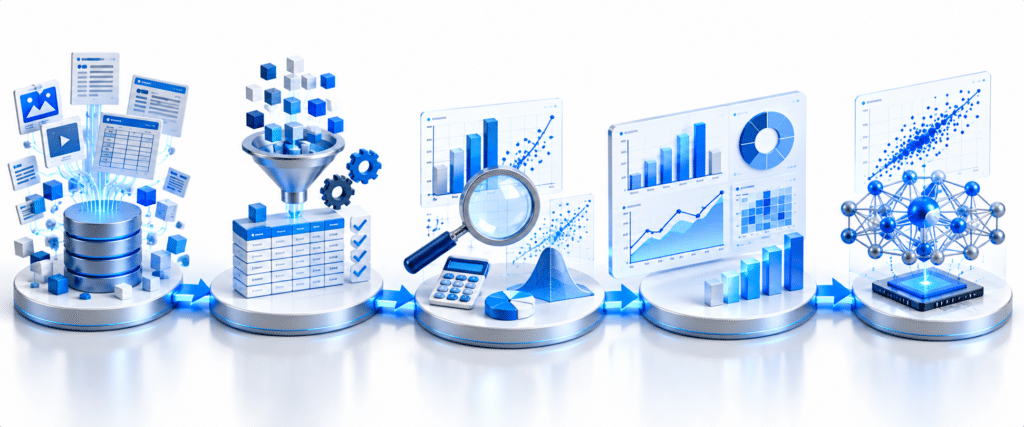
Data Visualization and Communication
Finding a pattern is only part of the job. Data professionals must also communicate what they discovered.
A bootcamp should introduce suitable chart types, clear labeling, sensible comparisons, and basic dashboard design. Students may use Python visualization libraries or tools such as Power BI and Tableau, depending on the curriculum.
The important skill is choosing a visual that helps answer a question.
For example, a line chart may help show how revenue changes over time, while a bar chart may make it easier to compare sales across product categories. A complicated chart is not necessarily more informative than a simple one.
Students should also practise writing short explanations of their findings, including relevant limitations and recommendations.
Does a Data Science Bootcamp Include Machine Learning and AI?
Many programs include an introduction to machine learning, while others concentrate on data analysis and programming. Some combine data science with artificial intelligence, deep learning, or generative AI.
Before enrolling, check which subjects are taught in depth and which are only introduced briefly.
Machine Learning Fundamentals
Machine learning involves developing systems that learn patterns from data to make predictions, classifications, or other useful outputs.
A beginner curriculum may introduce regression, classification, decision trees, model evaluation, and the difference between training and testing data.
Students should also learn about overfitting, data leakage, and the limitations of predictive models. These concepts help explain why a model can perform well during development but fail on new data.
A good learning exercise should involve more than running an existing notebook. Students should prepare the data, train a model, evaluate its performance, and explain what the results do and do not demonstrate.
The free Google Machine Learning Crash Course is one resource learners can use to explore machine learning concepts and practical exercises. Its recommended preparation includes Python and familiarity with relevant mathematical and data-handling concepts.
Artificial Intelligence and Deep Learning
Some bootcamps go beyond traditional machine learning and introduce neural networks, deep learning, or generative AI.
These subjects can be useful, but beginners should not overlook the fundamentals. Understanding data preparation, evaluation, and statistical reasoning makes it easier to judge whether an AI system is producing useful results.
Students interested in AI should check whether the program includes hands-on work or merely provides an overview of popular tools.
They should also consider their intended career. A learner interested in business reporting may benefit more from stronger SQL, visualization, and analytical skills than from an advanced deep learning module.
Online vs. In-Person Data Science Bootcamps
Both online and in-person programs can provide valuable training. The better option depends on how you learn, how much time you can commit, and the support available.
Online Bootcamps
An online data science bootcamp allows students to study without travelling to a classroom. Depending on the program, it may include recorded lectures, live classes, coding assignments, discussion groups, and instructor feedback.
Online learning can be convenient for working professionals and students who need a flexible schedule. It can also make programs accessible to people who do not live near a training center.
However, flexibility requires discipline. Students need to set aside regular study time and complete practical work even when nobody is monitoring their progress.
Before enrolling, confirm whether the course offers live support, assignment reviews, access to instructors, and a clear process for asking questions.
In-Person Bootcamps
An in-person program may provide a fixed schedule, direct interaction with instructors, and opportunities to work with classmates.
This environment can help learners who prefer face-to-face guidance and structured study sessions. Group projects may also encourage students to explain their reasoning and learn from different approaches.
The disadvantages can include travel expenses, location restrictions, and less flexibility for people with jobs or family responsibilities.
Which Format Should You Choose?
Compare the teaching method rather than assuming one format is automatically superior.
| Factor | Online bootcamp | In-person bootcamp |
|---|---|---|
| Schedule | May be flexible or fixed | Usually follows a set timetable |
| Location | Can be accessed remotely | Requires attendance at a location |
| Instructor support | Depends on the program | Often available directly during sessions |
| Networking | May use online groups and events | May offer more face-to-face interaction |
| Self-discipline | Important, especially for self-paced courses | Structured attendance may help |
| Additional costs | May reduce travel expenses | May involve travel and accommodation |
Ask for a sample lesson, course schedule, and explanation of how students receive feedback. These details often reveal more than the delivery format alone.
Can You Find a Free Data Science Bootcamp Online?
Yes, free learning resources can help you develop data science skills without committing to an expensive program. However, a free course and a complete bootcamp are not necessarily equivalent.
Some free resources teach one subject in depth, while others offer a sequence of short lessons. Students may need to combine several courses to cover Python, statistics, SQL, visualization, and machine learning.

Kaggle Learn
Kaggle Learn offers free courses covering topics such as Python, pandas, data visualization, SQL, and machine learning.
The lessons include practical exercises that help students apply concepts rather than only read about them. This can make the platform a useful starting point for beginners who want to practise coding.
A learner could begin with introductory programming, continue to Python and pandas, and then explore machine learning after gaining confidence with data manipulation.
Because the courses are organized into individual topics, students should plan their own learning sequence and complete independent projects to connect the lessons.
Codanics
Codanics offers learning resources related to Python, data analytics, data science, machine learning, and artificial intelligence, with courses taught in Urdu or Hindi.
This may be relevant to learners who prefer instruction in these languages. The website lists programs with different subjects, durations, and prices, so students should check the current course details before enrolling.
Do not assume that every program is free simply because the provider offers some free learning options. Review the specific course page for fees, access conditions, curriculum, and certificate details.
Other Free Learning Resources
Students can also explore the Google Machine Learning Crash Course when they are ready to study machine learning, and the scikit-learn MOOC for practical machine learning with Python.
These resources can complement a broader curriculum, but they are not replacements for every part of a data science education. Learners still need practice with data preparation, analysis, communication, and independent projects.
How to Build a Learning Path Without Paying for a Bootcamp
If your budget is limited, try following a planned sequence:
- Learn basic Python programming.
- Practise working with datasets using pandas.
- Study descriptive statistics and basic probability.
- Learn SQL for retrieving information from databases.
- Explore charts and data visualization.
- Complete introductory machine learning lessons.
- Build independent projects and document your findings.
This approach takes planning and consistent effort, but it allows you to develop foundational skills before deciding whether a paid bootcamp would provide enough additional value.
How to Evaluate a Bootcamp’s Cost, Certificate, and Job Guarantee
A program’s price should not be the only factor in your decision. A low-cost course may offer useful recorded lessons, while a more expensive bootcamp may provide live instruction, mentoring, detailed feedback, and career support.
The key is to understand exactly what you are paying for.
Compare the Total Cost
Look beyond the advertised tuition fee. Depending on the program, additional expenses may include software, cloud computing, examination fees, equipment, or optional mentoring.
Check whether the course includes access to all lessons and assignments for a reasonable period. Find out whether you will lose access after graduation or need to pay for continued support.
Compare programs based on their curriculum, teaching quality, practical projects, instructor access, and the amount of feedback students receive.
Understand What a Certificate Means
A certificate may show that you completed a course or met a program’s requirements. However, its value depends on the provider, the assessment process, and how relevant the training is to the work you want to do.
A certificate alone does not prove that you can solve unfamiliar problems or work independently with data.
Before enrolling, ask whether the program assesses practical skills, requires projects, and explains what students must do to receive the certificate.
A portfolio containing well-documented projects can help demonstrate your abilities alongside your educational credentials.
Be Careful With Job Guarantees
Some bootcamps advertise job guarantees or employment support. Read the terms carefully before treating these claims as a reason to enroll.
Find out whether the guarantee means a job placement, a refund, additional training, or some other benefit. Check eligibility conditions, application requirements, deadlines, geographic restrictions, and any exclusions.
Also ask for information about how the provider measures graduate outcomes. Employment statistics are more useful when they clearly explain the number of graduates included, the reporting period, the roles counted, and the method used to collect the data.
No bootcamp can responsibly guarantee that every student will secure a particular salary or job. Employment depends on factors such as prior experience, location, technical ability, communication skills, and market conditions.
Data Science vs. Data Analytics vs. Data Engineering
These fields overlap, but they focus on different parts of working with data. Understanding the differences can help you select a bootcamp that matches your goals.
Data Science
Data science combines programming, statistics, domain knowledge, and analytical methods to investigate questions and build models.
Depending on the role, a data scientist may develop predictive models, run experiments, evaluate results, or investigate complex patterns in large datasets.
A data science bootcamp may therefore include statistics, Python, machine learning, and model evaluation.
Data Analytics
Data analytics often focuses on examining existing data to explain performance, identify trends, and support business decisions.
Common tasks include writing SQL queries, preparing reports, building dashboards, and investigating why a metric has changed.
A data analytics bootcamp may emphasize spreadsheets, SQL, visualization tools, and practical business analysis. Some programs also include Python and introductory machine learning.
Data Engineering
Data engineering focuses on the systems and processes used to collect, transform, store, and deliver data.
Data engineers may build pipelines, manage databases, improve data quality, and support the infrastructure required by analysts and data scientists.
A data engineering program is more likely to emphasize SQL, databases, data pipelines, cloud platforms, and software engineering practices.
Which Path Is Right for You?
Consider the type of work you enjoy.
If you like investigating questions, understanding patterns, and developing predictive models, data science may suit you. If you prefer reports, dashboards, and business insights, data analytics may be a better starting point. If you enjoy building systems that move and organize information, explore data engineering.
You do not need to decide your entire career before beginning. Foundational skills such as Python, SQL, data handling, and analytical reasoning can support several paths.
Why Practical Projects Matter More Than Watching Lessons
A course can explain a concept clearly, but understanding improves when students apply it to unfamiliar problems.
Practical projects help learners practise the complete process: defining a question, finding or selecting data, cleaning it, conducting analysis, presenting results, and explaining limitations.
They also reveal gaps in understanding that may not appear during guided lessons.
Project 1: Sales Data Analysis
Use a sample sales dataset to investigate revenue trends, compare product categories, and identify the periods with the strongest or weakest performance.
Clean the dataset, calculate relevant measures, create visualizations, and write a short report explaining the findings.
This project can demonstrate skills in data cleaning, pandas, visualization, and communication.
Project 2: Customer Churn Analysis
Use an appropriate sample dataset to investigate which characteristics are associated with customers leaving a service.
Begin with exploratory analysis and then, if your skills allow, build a simple classification model. Evaluate its performance using suitable metrics and explain why the model should not automatically be treated as a reliable prediction for every customer.
This project can introduce classification, model evaluation, and the importance of understanding data limitations.
Project 3: Public Data Investigation
Choose an openly available dataset related to transport, education, public health, weather, or another topic that interests you.
Develop a clear research question, examine the data, select appropriate methods, and present your findings.
The value comes from showing how you think, not from choosing the most complicated dataset.
How to Present Projects in a Portfolio
For each project, explain:
- The question you wanted to answer.
- Where the data came from.
- How you cleaned and prepared it.
- Which tools and methods you used.
- What you discovered.
- What limitations affected your results.
- What you would investigate next.
You can share code through GitHub and present the results through a written report, notebook, or dashboard.
Make sure your project description is understandable to someone who is not a data scientist. Clear explanations help demonstrate that you can communicate findings as well as write code.
How Long Does It Take to Learn Data Science Through a Bootcamp?

There is no single timeline that applies to every student. The time required depends on the program’s intensity, your previous experience, the hours you can study, and the depth of the skills you want to develop.
A short course may introduce the main concepts without providing enough practice for independent work. A longer program may offer more time for projects, feedback, and advanced subjects.
Students should also consider the time required outside scheduled lessons. Reviewing code, debugging errors, completing assignments, and building a portfolio are important parts of learning.
Instead of choosing a program solely because it promises to teach data science quickly, examine what students are expected to accomplish by graduation.
Can graduates clean unfamiliar datasets? Can they write and explain their own code? Can they evaluate a model appropriately? Can they communicate the limitations of their findings?
These are more useful questions than whether a course promises to turn a complete beginner into an expert within a few weeks.
Frequently Asked Questions
What is a data science bootcamp?
A data science bootcamp is a structured training program that teaches skills such as programming, statistics, data analysis, visualization, and sometimes machine learning. Programs vary in length, depth, teaching format, and practical support.
Can I join a data science bootcamp for free?
Yes. Free online resources can help you learn Python, data analysis, and machine learning. Kaggle Learn, for example, offers free courses with practical exercises. However, a collection of free courses may not provide the instructor support, feedback, or structured projects included in some paid bootcamps.
Is an online data science bootcamp suitable for beginners?
It can be suitable if the program starts at an appropriate level and provides clear explanations, coding exercises, and access to help. Beginners should check whether Python and mathematics prerequisites are required before enrolling.
Do I need to know Python before joining?
Not always. Some bootcamps teach Python from the beginning, while others expect students to have programming experience. Check the prerequisites and try an introductory Python course if you are unsure about your current level.
Is a data science bootcamp better than a university degree?
Neither option is automatically better for everyone. A bootcamp may provide focused, practical training in a shorter period, while a university degree usually offers broader academic study and more time for theoretical foundations. Employers may also have different education requirements, so consider the roles you want to pursue.
Do data science bootcamps provide certificates?
Some programs provide certificates after students meet their completion requirements. Before enrolling, check who issues the certificate, what assessment is required, and whether the program evaluates practical work.
Can a data science bootcamp guarantee a job?
A bootcamp may offer career guidance, interview preparation, or a job guarantee with specific conditions. However, completing a program does not automatically lead to employment. Review any guarantee carefully and assess the quality of the curriculum and practical training.
What is the difference between a data science bootcamp and a data analytics bootcamp?
A data science bootcamp often includes statistical modeling and machine learning alongside programming and analysis. A data analytics bootcamp usually emphasizes understanding existing data, preparing reports, building dashboards, and supporting business decisions. The exact subjects vary by provider.
Does a data science bootcamp teach artificial intelligence?
Some programs include machine learning, deep learning, or generative AI, while others focus on foundational analysis. Review the curriculum to see which topics receive practical instruction rather than assuming every bootcamp covers all areas of AI.
What should I learn after completing a data science bootcamp?
Continue practising with independent projects, strengthen any weak areas, and study the tools relevant to your preferred career path. Depending on your goals, this may include advanced SQL, machine learning, statistics, cloud computing, data engineering, or model deployment.
Choosing a Bootcamp With Your Long-Term Goals in Mind
A data science bootcamp can provide a useful starting point, but the value of the experience depends on what you learn and how you apply it.
Look for a program that builds strong fundamentals, gives you meaningful practice, and helps you understand the reasoning behind analytical methods. Compare the curriculum, teaching support, projects, cost, and career claims before making a commitment.
If a paid bootcamp is beyond your current budget, start with free resources and build a consistent learning routine. Practise Python, work with real datasets, study statistics, and complete projects that answer meaningful questions.
As your skills improve, you can decide whether a structured paid program would fill gaps in your knowledge or provide support you cannot easily obtain through self-study.
The best data science bootcamp is not necessarily the most expensive or the shortest. It is the one that helps you develop skills you can demonstrate, explain, and use to solve real problems.
1-on-1 AI & Data Science Mentorship
Accelerate your career with personal coaching from Dr. Stylianos Kampakis. Tailored portfolio reviews, interview prep, and direct industry placement.
Building Autonomous AI & Data Agents with Python
Hands-on engineering course with ReAct agents, MCP tool integrations, and LangChain/CrewAI production patterns.