
Navigating UK Data Analytics Training
Enrolling in a commercial data analyst bootcamp in the UK requires evaluating how short-course syllabuses align with established national standards and employer expectations. Entry-level analytics positions across Britain are competitive, demanding measurable competence across data wrangling, structured query languages, dashboard development, and regulatory compliance.
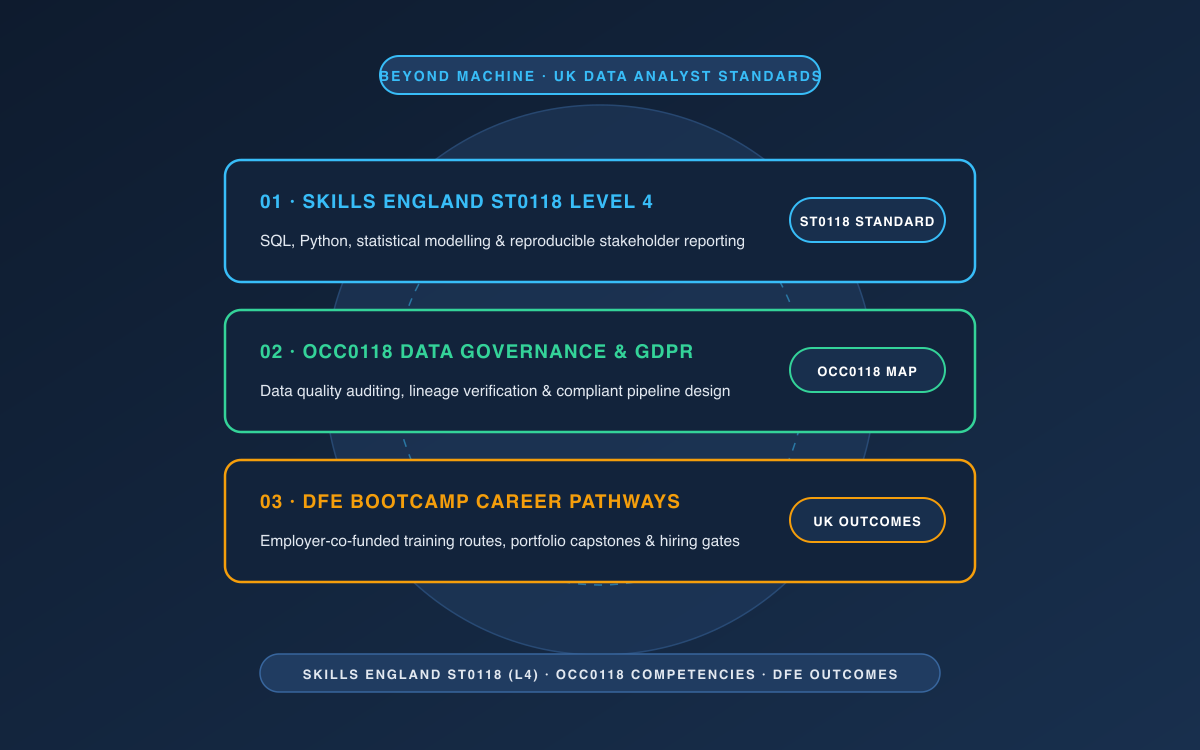
Rather than relying on marketing claims, prospective students should measure prospective training providers against verified occupational benchmarks, such as the Skills England ST0118 standard for Level 4 Data Analysts, and established industry frameworks. Understanding the differences between bootcamps, government-backed apprenticeships, and university degrees ensures that training investments directly translate to marketable skills in the UK recruitment landscape.
Core Competencies and Technical Skills Demanded by UK Employers
According to national career benchmarks published by Prospects UK, data analysts are primarily hired to collect, clean, organise, and interpret structured and unstructured datasets to answer specific business questions. The role demands combining technical data manipulation with stakeholder communication and data storytelling.
Entry-level job profiles and regulatory occupational maps outline a foundational core of tooling and methodologies:
- Data Querying and Manipulation: Fluent use of SQL to interrogate relational databases, alongside advanced use of spreadsheets (such as Excel) to manage and clean data. Scripting languages like Python or R are increasingly required for automated data preparation and statistical analysis.
- Data Visualisation and Reporting: Building production-ready dashboards and reports using business intelligence platforms such as Power BI or Tableau to track key performance indicators (KPIs).
- Statistical Analysis and Modelling: Understanding descriptive, predictive, and prescriptive analytics, as well as applying exploratory data analysis and time-series forecasting.
- Data Governance and Compliance: Working within enterprise data architecture and adhering strictly to data protection legislation, including the UK General Data Protection Regulation (GDPR) and the principles of Privacy by Design.
Mastering these fundamentals enables analysts to progress into more advanced disciplines. For professionals mapping out long-term trajectories, reading How to Transition from Data Analyst to AI Engineer in 2026: The Practical Roadmap provides clarity on how foundational query and scripting skills evolve into machine learning engineering over time.
Comparison of Pathways: Bootcamps, Apprenticeships, and Degrees
Entering the UK analytics industry does not depend on a single mandatory credential. Prospective professionals can choose between university education, intensive short-course training, and debt-free technical apprenticeships designed in collaboration with major employers.
| Pathway | Structure & Delivery | Benchmark / Framework | Key Advantages & Considerations |
|---|---|---|---|
| Commercial Short Course / Bootcamp | Intensive short courses (often modular, remote, or hybrid) focused on specific technical stacks. | Provider-specific; must be cross-checked against industry hiring expectations. | Offers accelerated learning of tools like SQL, Tableau, and Python, but requires careful vetting of curriculum rigor, depth, and market recognition. |
| Work-Based Apprenticeship | Paid employment combined with formal training (e.g., Level 3 Data Technician or Level 4 Data Analyst). | Skills England Level 4 Standard (OCC0118 / ST0118). | Employed on-the-job training created by employers such as UBS, Network Rail, and Estee Lauder; zero tuition fees, though application processes are competitive. |
| Higher Education Degree | Multi-year undergraduate (BSc) or postgraduate (MSc) academic study in STEM or quantitative fields. | Academic degree frameworks (Computer Science, Mathematics, Data Science, Statistics). | Comprehensive theoretical foundation in research methods and statistics; requires multi-year commitment and higher direct tuition costs. |
While university degrees provide robust theoretical grounding in statistical theory, short courses offer accelerated routes into software and query workflows. Conversely, formal apprenticeships integrate students directly into commercial environments, ensuring daily alignment with enterprise data policies and operational practices.
Data Bootcamp Curriculum Checklist: Aligning with National Standards
When assessing a UK bootcamp syllabus, compare its modular objectives against the duties defined in the approved Skills England ST0118 apprenticeship standard. An enterprise-aligned curriculum should systematically cover each stage of the data analysis lifecycle.
Use the following checklist to evaluate any prospective course syllabus:
- Data Lifecycle & Problem Scoping: Does the course teach requirement-gathering and scoping business questions before jumping into code?
- Data Cleaning & Validation: Does the training address real-world, messy datasets, teaching learners how to identify anomalies, handle missing values, and validate pipeline integrity?
- Database Systems & Interrogation: Does the curriculum cover database design, table relationships, structured queries, and joins, rather than solely relying on flat CSV files?
- Data Protection & Ethics: Are regulatory requirements such as GDPR, data storage limits, anonymisation, and Privacy by Design integrated into coursework?
- Communication & Storytelling: Are students evaluated on their ability to explain complex statistical outputs to non-technical stakeholders through written summaries and interactive dashboards?
Hypothetical Worked Project: Applying the Analysis Lifecycle
To understand the depth expected by UK hiring managers, consider a hypothetical portfolio scenario reflecting standard duties: an operational efficiency study for an NHS hospital trust experiencing department wait times, reflecting scenarios referenced in the national occupational standard.
A rigorous portfolio project executes distinct operational phases:
- Requirement Gathering & Scoping: Defining the primary operational question: which intake triage steps create the largest bottlenecks in specific clinical departments?
- Data Compilation and Ingestion: Querying appointment tables, admissions, and timestamp logs using SQL while ensuring patient identifying records are stripped in accordance with GDPR principles.
- Cleansing & Quality Mitigation: Identifying duplicate timestamps, treating missing discharge times, and documenting data anomalies to ensure reliable baseline figures.
- Exploratory Analysis: Running descriptive statistics and time-series trends to identify differences across operating hours, peak days, and staffing variations.
- Visual Dashboard & Translation: Developing a Power BI or Tableau dashboard showing triage bottlenecks alongside an executive summary detailing resource reallocation recommendations.
Projects of this caliber prove that an analyst can connect raw data to measurable organisational choices, providing far more impact during an interview than generic academic exercises.
UK Salary Expectations and Career Progression
Data compiled by Prospects UK and the National Careers Service reveals clear compensation bands for data analysts across the UK market. Starting salaries for junior data analysts typically range from £28,000 to £32,000, while Skills England records a median salary across all levels of £33,977.
With accumulated experience, mid-level analysts earn between £35,000 and £50,000. Experienced and senior data analysts, team leads, and analytics managers can see compensation rise between £50,000 and £65,000 or more, particularly within high-demand sectors such as financial services, consulting, and technology.
Professionals aiming to advance can pursue professional recognition, such as the Data Analyst professional status offered by the Royal Statistical Society, or transition across technical pathways. For instance, analysts who build rigorous Python and automated pipeline capabilities can consult How to Transition from Data Analyst to AI Engineer in 2026: The Practical Roadmap to plan an orderly shift into machine learning architecture.
Critical Questions to Ask a Bootcamp Provider Before Enrolling
Before committing tuition fees or personal time to a private data training program, prospective students should conduct thorough due diligence. Ensure you ask the following questions directly to admissions and academic teams:
- What is the breakdown of tools taught? Confirm whether the syllabus covers industry-standard tools like SQL, Excel, and Power BI or Tableau, and verify whether Python or R is included.
- How are portfolio projects structured? Determine whether students build independent projects using open-access or simulated business data, or simply follow pre-written instructor notebooks.
- Does the curriculum incorporate data governance and GDPR? Ask how the course addresses regulatory frameworks, ethical handling, and security standards required in the UK workplace.
- What continuous professional development pathways are supported? Find out if the training maps toward credentials from recognized professional bodies like BCS (The Chartered Institute for IT) or the Royal Statistical Society.
Frequently Asked Questions
- Can I become a data analyst in the UK without a university degree?
- Yes. While many employers historically preferred degrees in quantitative disciplines such as computer science or mathematics, structured pathways such as Level 3 Data Technician and Level 4 Data Analyst apprenticeships, as well as focused short courses paired with a strong portfolio, provide established alternative routes into the industry.
- What tools should an entry-level UK data analyst learn first?
- Industry profiles consistently indicate that SQL, advanced spreadsheets (Excel), and dashboarding software such as Power BI or Tableau form the core toolset. Scripting languages like Python or R provide additional competitive advantage for automated data preparation and statistical analysis.
- What is the difference between a data analyst and a data scientist?
- According to national occupational profiles, data analysts focus on answering business questions, identifying trends, maintaining reporting pipelines, and presenting findings to stakeholders. Data scientists typically work more heavily with complex algorithms, data mining, machine learning models, and advanced statistical programming to build predictive prototypes.
References
1-on-1 AI & Data Science Mentorship
Accelerate your career with personal coaching from Dr. Stylianos Kampakis. Tailored portfolio reviews, interview prep, and direct industry placement.
Atlas Paragon Small Business Operations & Security Guides
Independent, evidence-backed checklists for small-business software selection, accounting workflows, and security.