Architectural Foundations of Python in Data Science
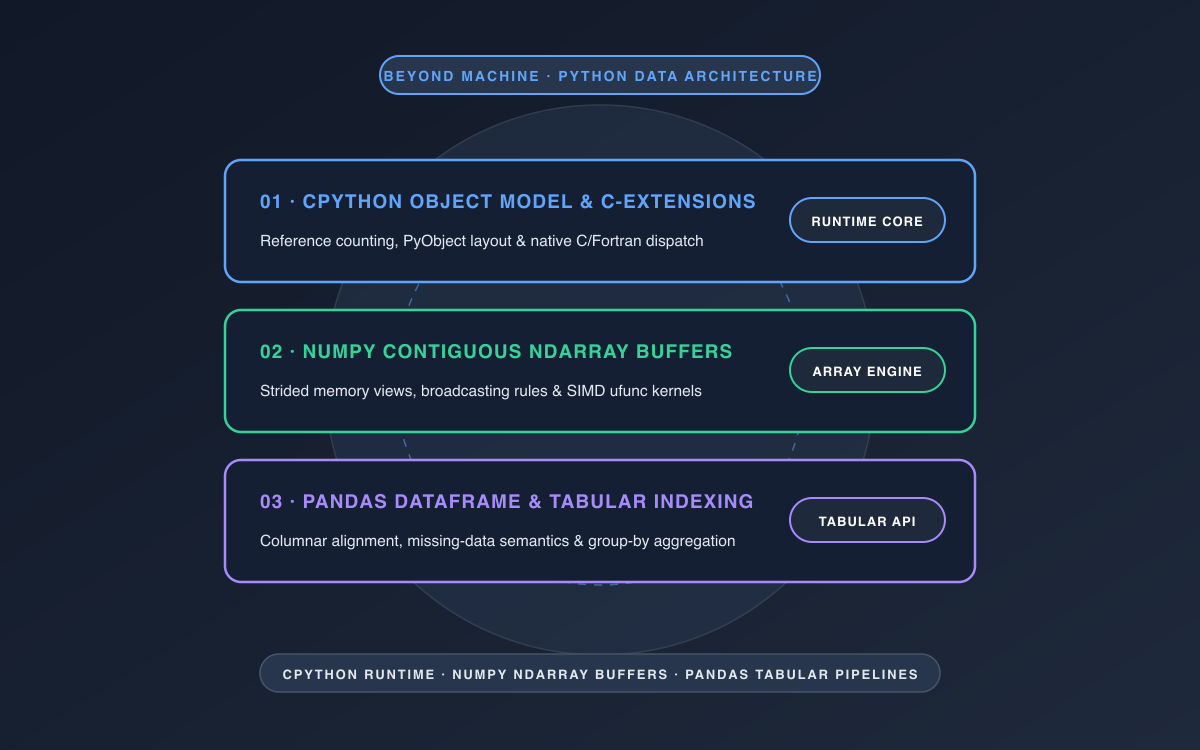
Using Python for data science centers on a layered computation stack that translates high-level scripting into efficient, low-overhead numerical operations. At the base lies the core Python runtime, which provides dynamic typing, standard arithmetic, and sequential data types. Because standard Python collections store references to heterogeneous objects, scientific computing relies on specialized libraries to execute vectorized calculations directly in contiguous memory.
The primary numerical computing layer is established by NumPy, which introduces the homogeneous N-dimensional array. Building upon this base, pandas provides labeled two-dimensional data structures designed for statistical computing and data cleaning. Together, these tools form an interoperability standard used across scientific research and industrial pipelines. As prospective practitioners evaluate whether to study data science or data analysis, mastering the core array and data frame abstractions remains the necessary technical prerequisite.
Core Python Foundations: Numeric Types and Sequence Slicing
The standard Python interpreter provides the foundational syntax used to manipulate data, variables, and expressions. In the official Python documentation, the interpreter is described as executing direct arithmetic operations with clear typing rules. Standard integers have type int, whereas fractional values are classified as float. Operations such as division (/) always evaluate to floating-point numbers, while floor division (//) truncates fractional values, and modulus (%) extracts remainders.
Sequences such as strings and lists introduce 0-indexed subscripting. Python sequence indices start at 0 for the initial item and support negative integers to access elements from the reverse direction, where -1 points to the final element. Slicing syntax, written as [start:end], includes the boundary element at the start index while excluding the boundary element at the end index. This principle guarantees that consecutive slices maintain contiguous alignment across data sequences.
Array Programming and Vectorized Execution with NumPy
Standard Python lists are versatile, general-purpose containers that accommodate heterogeneous elements, but they incur performance overhead on large datasets due to pointer chasing and object abstraction. As documented in the NumPy beginner guide, NumPy resolves this limitation by introducing the ndarray: a homogeneous, N-dimensional grid where every element shares identical memory size and precision (such as int64 or float64).
Academic research published in Nature by Harris et al., titled Array programming with NumPy, highlights that array programming provides a compact and expressive syntax for operating on matrices and higher-dimensional arrays. NumPy has served as foundational infrastructure in landmark scientific research analysis pipelines, including the imaging of a black hole and the empirical detection of gravitational waves. The paper emphasizes that NumPy acts as an interoperability layer across the broader scientific computing ecosystem.
An essential behavioral distinction between Python lists and NumPy arrays lies in indexing. While slicing a native Python list creates an independent copy, slicing a NumPy array produces a memory view that directly references the original memory buffer. Altering an element within an array view mutates the underlying original array. Array shapes are fixed at instantiation, rectangular across dimensions, and inspected via structural attributes: ndim (number of axes), shape (tuple of dimension extents), size (total element count), and dtype (data type).
Tabular Data Modeling and Analysis with pandas
While NumPy handles raw numerical grids, statistical computing demands labeled rows, named columns, and mixed-type storage. Wes McKinney introduced these concepts in the foundational paper Data Structures for Statistical Computing in Python, presenting dedicated abstractions to manage missing data, tabular alignment, and time-series observations.
According to the official pandas 10-minute guide, the library provides two core classes: the 1-dimensional labeled Series and the 2-dimensional tabular DataFrame. Unlike an ndarray, each individual column in a DataFrame maintains its own distinct dtype, permitting numeric floats, integers, strings, timestamps, and categorical variables to coexist alongside one another in the same dataset.
When converting tabular data to raw arrays via DataFrame.to_numpy(), pandas evaluates the underlying column types. If column datatypes vary across the frame, pandas resolves to a common denominator type such as object, which requires explicit data copying rather than zero-copy memory views. High-level exploratory workflows depend on built-in routines like describe() to calculate counts, means, standard deviations, and quartiles across numeric fields, alongside head() and tail() for inspecting frame boundaries.
Structural Comparison: Python Lists, NumPy ndarrays, and pandas DataFrames
Selecting the proper data structure depends on homogeneity, dimensional requirements, and labeling needs. The table below outlines the core properties defined in the official documentation for each container.
| Container | Homogeneity | Dimensionality | Slicing Behavior | Primary Use Case |
|---|---|---|---|---|
| Python List | Heterogeneous (mixed element types) | 1-D sequence (arbitrarily nestable) | Returns a copy | General-purpose collections and sequential control flow |
| NumPy ndarray | Homogeneous (single dtype per array) | N-dimensional rectangular grid | Returns a view (mutations modify parent array) | Dense numerical computing, linear algebra, CPU vectorization |
| pandas DataFrame | Heterogeneous across columns (single dtype per column) | 2-D labeled table | Label (loc) or position (iloc) indexer access |
Data wrangling, statistical analysis, mixed-type structured data |
Professionals must understand how memory layouts differ between these structures, as structural choices dictate runtime complexity and memory utilization.
Data Access Paradigms: Label-Based vs. Positional Indexing
Accessing data inside a pandas DataFrame requires distinguishing between label-based and position-based access. Standard bracket notation (df['A']) extracts a named column as a Series, while standard integer slices across the bracket indexer filter consecutive rows.
For production code and unambiguous data extraction, the pandas documentation specifies explicit accessors:
- Label-Based Indexing (
loc,at): Accesses values by their assigned index or column label. When using label slices withinloc, both the start and end boundary labels are inclusive. Theataccessor offers optimized scalar retrieval for specific label pairs. - Position-Based Indexing (
iloc,iat): Operates using 0-indexed integer offsets. Like standard Python sequence slicing, the end position in anilocslice is excluded. Theiatmethod provides fast integer-location scalar lookups.
Adhering to explicit accessors prevents unexpected slicing behavior, particularly when dealing with non-consecutive or non-integer indices.
Illustrative Code Workflow
The following script demonstrates standard initialization patterns for NumPy arrays and pandas DataFrames using conventions established in their official manuals.
Illustrative example; not executed or benchmarked.
import numpy as np
import pandas as pd

# Instantiate a 1D NumPy array and examine memory properties
arr = np.array([1, 2, 3, 4, 5, 6], dtype=np.int64)
print("Array shape:", arr.shape)
print("Array dimensions:", arr.ndim)

# Construct a 2D labeled DataFrame using dates and random values
dates = pd.date_range("20260101", periods=4)
df = pd.DataFrame(np.ones((4, 3)), index=dates, columns=list("ABC"))

# Perform explicit label-based and position-based data selection
first_column = df["A"]
row_by_label = df.loc[dates[0], ["A", "B"]]
row_by_position = df.iloc[0:2, 0:2]

# Statistical summary across the frame
summary = df.describe()
Understanding these initialization and extraction paradigms helps practitioners structure programmatic analysis cleanly.
Source-Backed Checklist for Python Data Workflows
When implementing data analysis routines in Python, align your pipeline with verified documentation standards:
- Confirm Homogeneity Requirements: Use NumPy arrays when processing large, uniform numeric datasets where memory contiguousness and CPU performance matter.
- Track Views vs. Copies: Remember that slicing a NumPy array creates a view. Verify whether mutations are intended to propagate back to the parent array before modifying slice values.
- Enforce Explicit Pandas Accessors: Prefer
locfor label references andilocfor integer offsets to avoid ambiguity in production scripts. - Inspect Mixed Dtypes: Check
DataFrame.dtypesprior to callingto_numpy()to anticipate whether type coercion toobjectwill cause memory copying. - Validate Sequence Boundaries: Remember that standard Python and
ilocslices exclude the end index, whereas pandasloclabel slicing includes both endpoints.
Frequently Asked Questions
Why does NumPy use a single dtype for an entire array?
Enforcing a single, homogeneous data type allows NumPy to store elements in a contiguous block of memory. This enables the library to avoid Python object overhead, optimize CPU caching, and execute vectorized mathematical operations efficiently.
What is the difference between pandas loc and iloc?
The loc indexer selects data according to user-defined labels (such as index names or column strings) and includes both slice endpoints. The iloc indexer selects data strictly by 0-based integer positional coordinates and excludes the ending slice index.
When should data be converted from a DataFrame to a NumPy array?
Converting a DataFrame to an array via DataFrame.to_numpy() is useful when passing tabular data into pure numerical functions or linear algebra operations. However, if the DataFrame columns contain mixed types, pandas will produce an array with dtype object, requiring a full memory copy.
References
- Python Software Foundation — 3. An Informal Introduction to Python (Python 3.15 Documentation)
- NumPy Developers — NumPy: the absolute basics for beginners (v2.5 Manual)
- pandas Development Team — 10 minutes to pandas (pandas 3.0.6 documentation)
- Harris, C. R., Millman, K. J., van der Walt, S. J., Gommers, R., Virtanen, P., et al. (2020) — Array programming with NumPy. Nature, 585, 357–362
- McKinney, W. (2010) — Data Structures for Statistical Computing in Python. Proceedings of the 9th Python in Science Conference, Austin, 56-61
Building Autonomous AI & Data Agents with Python
Master ReAct frameworks, Model Context Protocol (MCP), and multi-agent coordination from industry practitioners.
Building Autonomous AI & Data Agents with Python
Hands-on engineering course with ReAct agents, MCP tool integrations, and LangChain/CrewAI production patterns.