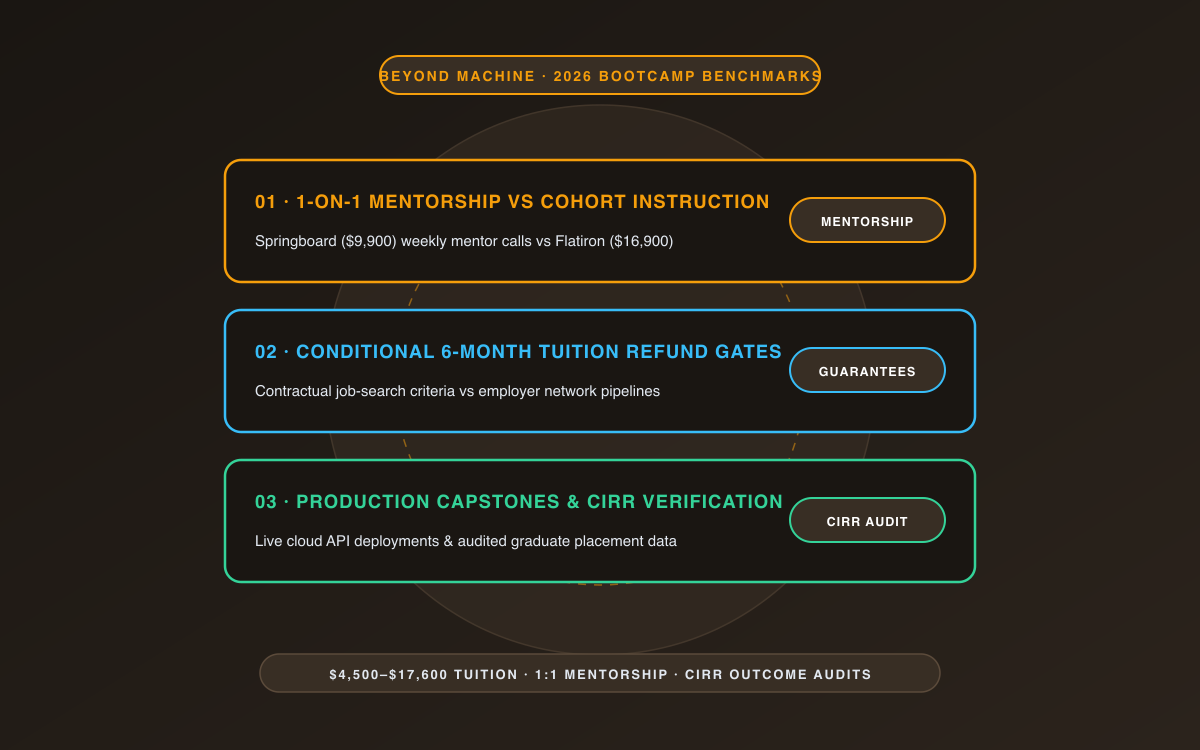
Data science bootcamps in 2026 range in cost from $4,500 to $17,600, offering varying levels of individualized mentorship, project-driven coursework, and post-graduation career placement. Evaluating whether an intensive program aligns with your career goals requires looking beyond headline placement metrics to assess three operational pillars: the depth of one-on-one industry mentorship, whether capstone portfolios solve genuine production-grade data problems, and whether career support relies on passive job boards, large employer networks, or conditional tuition-refund guarantees.
Evaluating Data Science Bootcamps in 2026
The tech hiring market places a premium on demonstrable practical capability. Data science bootcamps are intensive training programs designed to compress the timeline required to acquire core competencies in statistical analysis, Python, SQL, and machine learning workflows. While traditional degree programs provide multi-year academic theoretical grounding, bootcamps target immediate vocational application, typically spanning 12 to 16 weeks in full-time cohorts or up to 9 months in self-paced formats.
For professionals evaluating whether to transition into technical roles, knowing whether an intensive curriculum yields tangible returns is critical. Prospective students frequently ask, can I learn data science and land a high-paying job? The answer depends heavily on the program’s rigor, admissions screening, and the depth of hands-on skills developed. High-performing bootcamps emphasize core tools such as Python, R, and relational databases, while teaching learners to clean unstructured data, build predictive pipelines, and deploy analytical models.
1-on-1 Mentorship Models vs. Cohort Office Hours
Mentorship structures represent one of the primary operational differentiators between top-tier and entry-level bootcamps. Self-directed study often stalls when learners hit complex conceptual barriers in statistical modeling or model evaluation. Dedicated one-on-one mentorship bridges this gap by pairing students with active data professionals who review code, critique architectural choices, and provide industry perspective.
Programs like Springboard and Chegg Skills (formerly Thinkful) embed regular, dedicated 1-on-1 mentor sessions directly into the curriculum. In these environments, students meet weekly with practicing data scientists to discuss capstone blockers, code maintainability, and domain-specific challenges. Understanding how mentoring can help you land a job in data science is essential when comparing programs; individualized guidance not only ensures code quality but also develops the professional communication skills needed to explain data insights to executive stakeholders.
Conversely, other providers rely primarily on shared group office hours or teaching assistants. While group forums encourage community problem-solving, they rarely provide the line-by-line code critique or personalized career trajectory coaching found in dedicated one-on-one models.
Portfolio Projects and Technical Capstones
A static resume rarely distinguishes an applicant in an automated applicant tracking system. Modern hiring managers evaluate candidates on their ability to solve real business problems, making the capstone portfolio the central artifact of any bootcamp graduate’s application packet.
High-value bootcamps steer students away from generic academic datasets such as Iris or Titanic survival data. Instead, they require end-to-end development lifecycles: ingesting raw data from third-party APIs or SQL databases, performing exploratory data analysis, designing machine learning models, and presenting findings via interactive dashboards. Leading institutions such as NYC Data Science Academy incorporate GitHub code reviews, mock technical presentations, and advanced frameworks like Spark and data engineering pipelines to ensure that projects mirror enterprise production environments.
Job Placement Support, Networks, and Refund Guarantees
Career services vary from loose alumni directories to legally binding tuition-refund commitments. Navigating these options requires understanding the operational differences between job assistance networks and formal guarantees:
- Conditional Tuition Refund Guarantees: Offered by programs like Springboard and Flatiron School, these agreements guarantee that eligible graduates who do not secure a qualifying role within six months of completion receive a full tuition refund. However, these guarantees carry strict operational prerequisites, including applying to a set number of jobs weekly, attending career coaching sessions, and maintaining geographic or work authorization eligibility.
- Hiring Partner Networks and Employer Introductions: Providers like General Assembly leverage established employer networks built over more than a decade. While they do not offer money-back guarantees, their institutional reach provides graduates access to exclusive job fairs, employer showcases, and recruiter panels.
- Career Coaching and Technical Interview Prep: Standard career services at schools like BrainStation and Chegg Skills focus on resume optimization, portfolio review, behavioral interview drills, and whiteboarding exercises.
2026 Data Science Bootcamp Comparison
The table below summarizes tuition costs, delivery formats, mentorship structures, and placement policies across major data science bootcamps based on 2026 data. Published rates reflect upfront costs as well as monthly installment options, while placement models distinguish between direct institutional networks and contractually binding refund agreements.
| Bootcamp | Estimated Tuition (2026) | Format | Mentorship Structure | Job Placement & Guarantees |
|---|---|---|---|---|
| Springboard | ~$9,900 upfront (or ~$1,890/month) | Online, flexible pacing | 1:1 weekly calls with active data scientist | Conditional 100% tuition refund if unhired within 6 months |
| General Assembly | ~$4,500 – $15,000 | Online & in-person (Full-time & Part-time) | Cohort instructors & career coaching staff | No formal guarantee; broad corporate hiring network and career fairs |
| Chegg Skills (formerly Thinkful) | ~$4,600 – $16,000 | Online, flexible | Dedicated 1:1 professional mentorship | No hard guarantee; dedicated career services and partner network |
| NYC Data Science Academy | ~$17,600 | In-person & online immersive | Faculty mentorship & technical GitHub reviews | Direct employer presentations, partner matchmaking, and interview prep |
| BrainStation | ~$15,000 – $16,500 | Online & in-person (Full-time & Part-time) | Industry professional instructors & project feedback | Exposure to hiring pipelines and employer showcases; no hard guarantee |
| Flatiron School | ~$16,900 | Online & in-person (Full-time & Part-time) | Dedicated career coaches & technical instructors | Conditional tuition refund policy for eligible graduates |
Auditing Placement Rates: CIRR Standards and White-Label Risks
Unverified marketing claims often present inflated placement metrics exceeding 90%. To determine real employment outcomes, prospective students must examine whether an institution adheres to independent reporting benchmarks such as the CIRR Standards established by the Council on Integrity in Results Reporting.
CIRR is a nonprofit body enforcing standardized outcome reporting through six foundational principles: truth in advertising, tracking student career intent on day one to prevent retrospective manipulation, complete tracking from enrollment through graduation, comprehensive job and salary reporting, standardized annual publications, and mandatory annual third-party audits. These standards verify in-field job placement rates, median starting salaries, and the time required for graduates to secure employment.
Evaluating independent data is crucial when assessing provider credibility, as detailed in our Institute of Data review on success rates and job placement data. Prospective students must also exercise caution regarding university-partnered coding bootcamps. Academic research examining bootcamp structures, such as the Utah State University thesis by Logan L. Hendricks, highlights the risks associated with white-label bootcamp models. In these arrangements, third-party commercial providers license university branding without delivering core university faculty or oversight, frequently resulting in misaligned expectations once learners discover the third-party relationship.
Tuition Models and Financing Structures
Because coding and data science bootcamps do not currently qualify for federal student aid, candidates must navigate private funding models. Standard tuition packages range widely, with historical baseline costs documented by RTI Press between $7,500 and $13,950, and premium specialized programs reaching upwards of $17,600. Assessing these payment mechanisms is necessary to understand total capital outlay and contractual risk across three standard pathways:
- Upfront Payment Discounts: Paying tuition in full before cohort initiation typically secures the lowest gross cost, waiving interest and administrative fees.
- Installment Financing and Private Loans: Monthly installment plans spread payments across the duration of the program, though private educational lenders may introduce financing interest.
- Deferred Tuition and Income Share Agreements (ISAs): Some providers permit students to defer tuition payments until they secure a qualifying role in their field. While functionally similar to a safety net, candidates must scrutinize the repayment thresholds, maximum payment caps, and payment durations outlined in the contract terms.
Strategic Decision Framework: Selecting Your Program
Choosing the right data science bootcamp requires balancing your existing technical baseline against program pacing, personal learning style, and specific career goals. An engineer seeking to master MLOps requires a curriculum substantially different from a career switcher building foundational data literacy. Three primary candidate profiles illustrate how to match requirements to provider strengths:
- For Software Engineers Upskilling: Candidates who already understand core programming principles and SQL can bypass foundational syntax and focus on advanced machine learning algorithms, deep learning pipelines, and distributed systems. Rigorous immersive programs like NYC Data Science Academy offer the mathematical and architectural depth suited to experienced developers.
- For Career Changers Needing Risk Mitigation: Non-technical professionals or career switchers who require a financial safety net should prioritize programs offering conditional tuition refunds, such as Springboard, or established 1-on-1 mentorship structures like Chegg Skills.
- For Learners Prioritizing Networking: Individuals targeting immediate local hiring pipelines should favor programs with physical campus footprints and active regional employer partnerships, such as General Assembly or BrainStation.
Frequently Asked Questions
- Do data science bootcamps qualify for federal financial aid?
- No. Coding and data science bootcamps are not accredited higher education institutions eligible for federal financial aid programs like Pell Grants or Title IV loans. Learners finance programs via upfront payments, installment plans, private student loans, or income share agreements.
- What core programming languages are taught in data science bootcamps?
- Virtually all recognized data science bootcamps focus on Python, SQL, and frequently R. Advanced immersive programs also introduce distributed data engineering tools such as Apache Spark.
- How does a job placement guarantee actually work?
- A job guarantee is typically a conditional tuition-refund policy. If an eligible graduate fails to secure a qualifying job within a specified window (commonly six months), the institution refunds their tuition. Retaining eligibility requires meeting rigid rules, such as submitting a set number of job applications per week, attending career coaching, and maintaining geographical flexibility.
References
- Council on Integrity in Results Reporting. CIRR Reporting Standards. Setting the Benchmark for Tech Education Transparency.
- Hendricks, Logan L. (2023). Coding Bootcamps – Perceptions and Outcomes. Master’s Thesis, Utah State University.
- Executive Levels. (2026). Data Science Bootcamps With Job Placement (2026 Guide).
- ComputerScience.org. CIRR-Verified Bootcamps Guide and Analysis.
1-on-1 AI & Data Science Mentorship
Accelerate your career with personal coaching from Dr. Stylianos Kampakis. Tailored portfolio reviews, interview prep, and direct industry placement.
1-on-1 VIP Mentorship & AI Bootcamp Application
Personalized career acceleration and portfolio review directly with Dr. Stylianos Kampakis.