
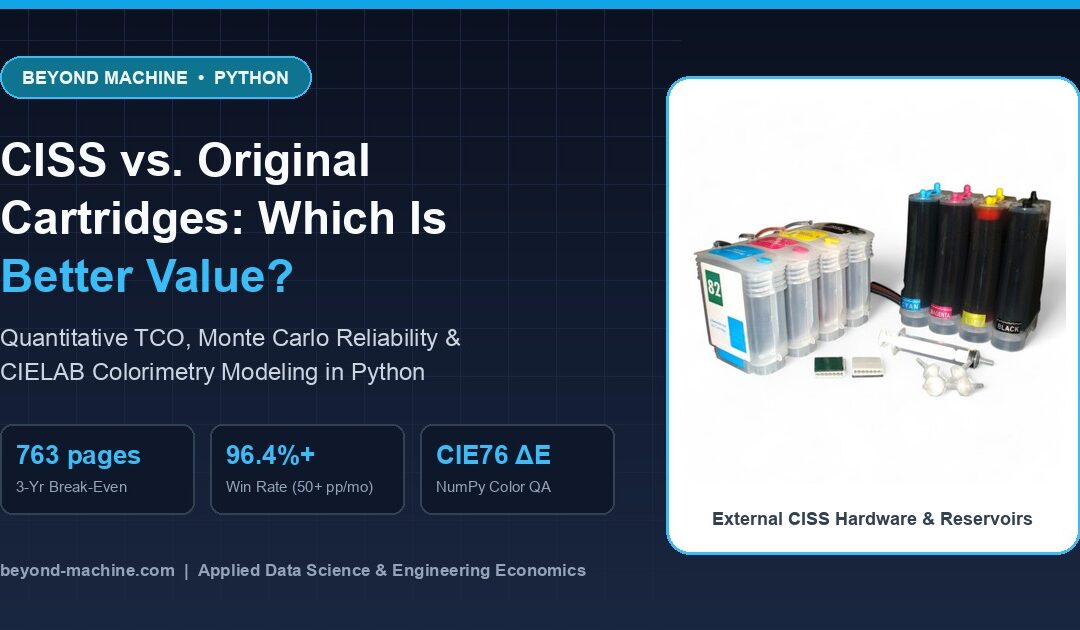
Comparing a continuous ink supply system (CISS) against original manufacturer cartridges is a classic applied engineering economics and stochastic decision-modeling problem: trading fixed upfront capital expenditure and maintenance hazard risk against an order-of-magnitude drop in variable cost per page. For data scientists and engineers evaluating office print fleets or building hardware cost-telemetry pipelines in Python, deterministic break-even math alone is misleading at low duty cycles because intermittent usage inflates nozzle-clogging overhead. Running a vectorized Monte Carlo simulation across realistic European consumable prices shows that original cartridges generally deliver better value below roughly 20 to 30 pages per month, whereas students, small offices, and copy centres printing consistently each week recover a CISS retrofit quickly and cut multi-year printing expenses dramatically.
To move from qualitative buying advice to a reproducible quantitative framework, this analysis pairs hardware fluid-delivery mechanics and standardized cartridge characterization with executable Python code for total cost of ownership (TCO) simulation, Poisson maintenance-risk modeling, and CIELAB colorimetric drift inspection.
Hardware Architecture and Fluid-Delivery Parameters: CISS vs. Original Cartridges
Any reliable TCO or failure-rate model begins by specifying the physical system boundary and its discrete cost drivers. An original cartridge is a consumable manufactured by or for the printer vendor for a specific printer model and discarded once exhausted. In drop-on-demand (DOD) inkjet systems, desktop devices rely primarily on thermal DOD or piezoelectric DOD printheads firing aqueous inks composed of water, glycol, and dyes or pigments. Entry-level printers frequently couple disposable ink tanks with integrated disposable printheads: every replacement cartridge swaps in a fresh nozzle array, bounding printhead repair risk at the price of steep per-page consumables.
A continuous ink supply system (CISS)—also designated in engineering literature as a bulk feed ink system (BFIS) or off-axis ink delivery system (OIDS)—separates bulk liquid ink reservoirs from the reciprocating print carriage. Flexible tubing feeds ink from stationary external bottles to carriage-mounted adapter cartridges, reducing moving carriage mass and inertia on faster mechanisms while eliminating frequent cartridge swaps. Retrofit CISS assemblies regulate pressure through a constant-level barometric design: a front chamber vented to atmosphere balances negative gauge pressure in the rear reservoir so ink flows steadily without flooding nozzles or starving the head.
From a systems-classification standpoint, an aftermarket external CISS must be distinguished from factory-integrated supertank models such as Epson EcoTank printers. Supertank hardware integrates high-capacity refillable reservoirs into the chassis at manufacture, whereas an external CISS is an aftermarket hardware add-on installed onto a compatible cartridge-based inkjet printer. Analysts parameterizing local European retrofit kits and compatible bulk-ink pricing for fleet cost models can inspect real-world hardware configurations through specialist suppliers such as Printout24 alongside official OEM consumable schedules.
European Cost-per-Page Benchmarks and Lifecycle TCO Equations
Marginal ink cost is where cartridge and bulk-tank architectures diverge most sharply. On-carriage consumer cartridges carry small ink capacities—sometimes as little as 10 mL—so steady printing triggers constant replacements. Crucially for yield modeling, every cartridge replacement is typically followed by an automatic head-cleaning cycle to expel air bubbles, consuming additional liquid ink before productive printing resumes.
Two concrete retail reference points from the European market anchor the lower and upper bounds of nominal per-page black ink pricing:
- HP 305 Black: Listed on HP’s official German website at €15.49 with a stated yield of approximately 120 pages, producing a nominal rate of roughly €0.129 per page.
- Epson 103 Black: Listed on Epson’s official German website at €10.80 for an original 65 ml black ink bottle with a stated yield of up to 4,500 pages, producing a nominal rate of roughly €0.0024 per page.
Analysts must treat these two reference values strictly as illustrative order-of-magnitude anchors rather than a controlled laboratory comparison between an external CISS and a cartridge: they represent distinct printers, printhead technologies, and vendor test conditions. While standards such as ISO/IEC 29142-1:2021 define formal terms, symbols, notations, and characterization frameworks for evaluating office print cartridges, realized page yields in production environments vary with document ink coverage, paper stock, print mode, and idle intervals.
Applying formal total cost of ownership (TCO) accounting captures direct acquisition cost, recurring consumables, routine servicing, and unscheduled maintenance across a service horizon of \(T\) months:
\[
\mathrm{TCO}_s(V, T) = C_{\text{capex}, s} + \frac{T}{12}\, C_{\text{maint}, s} + E_{\text{repair}, s}(V, T) + \sum_{t=1}^{T} V_t \, \frac{c_{\text{nom}, s}}{1 - w_s} \, \kappa_t
\]
In this formulation, \(C_{\text{capex}, s}\) is upfront hardware and installation expenditure for supply option \(s \in \{\text{orig}, \text{CISS}\}\), \(C_{\text{maint}, s}\) is annual preventive maintenance, \(E_{\text{repair}, s}(V, T)\) is the stochastic cost of unscheduled interventions (such as clearing air locks or dried nozzles), \(V_t\) is monthly page volume, \(c_{\text{nom}, s}\) is nominal ink cost per page, \(w_s \in [0, 1)\) is the share of ink lost to priming and head-cleaning cycles, and \(\kappa_t\) is a dimensionless coverage multiplier relative to nominal test patterns. Setting stochastic repair costs to zero gives the deterministic break-even volume \(N^*\) over \(Y = T/12\) years:
\[
N^* = \frac{\left(C_{\text{capex}, \text{CISS}} - C_{\text{capex}, \text{orig}}\right) + Y \left(C_{\text{maint}, \text{CISS}} - C_{\text{maint}, \text{orig}}\right)}{\dfrac{c_{\text{nom}, \text{orig}}}{1 - w_{\text{orig}}} - \dfrac{c_{\text{nom}, \text{CISS}}}{1 - w_{\text{CISS}}}}
\]
Stochastic Break-Even and Reliability Simulation in Python
Deterministic break-even equations fail to expose downside variance when usage is erratic or page coverage deviates from nominal office text. A practical data science workflow encodes supply profiles with Python’s typed dataclasses module, generates reproducible draws through NumPy’s default_rng (PCG64) random generator, and aggregates scenario quantiles inside a pandas DataFrame. For engineers looking to strengthen the underlying array and tabular mechanics used here, see our guide on NumPy and pandas data structures in Python.
The executable Python model below seeds nominal ink prices with the European retail figures above (€15.49 / 120 pages and €10.80 / 4,500 pages) and introduces explicit illustrative sensitivity assumptions for an external CISS retrofit (€65 upfront kit and setup, €15/year routine maintenance, 12% cartridge priming loss versus 6% CISS waste, lognormal coverage dispersion \(\sigma = 0.20\), and a higher Poisson nozzle-clog remediation rate below 50 pages/month). Substitute measured vendor quotes and print-server page counts to calibrate the script to a real office deployment.
from dataclasses import dataclass
import numpy as np
import pandas as pd


@dataclass(frozen=True)
class InkSupplyProfile:
    name: str
    upfront_capex_eur: float
    nominal_cost_per_page_eur: float
    annual_maintenance_eur: float
    cleaning_waste_ratio: float


def break_even_pages(
    orig: InkSupplyProfile,
    ciss: InkSupplyProfile,
    horizon_years: float = 3.0,
) -> float:
    fixed_diff = (ciss.upfront_capex_eur - orig.upfront_capex_eur) + horizon_years * (
        ciss.annual_maintenance_eur - orig.annual_maintenance_eur
    )
    eff_orig = orig.nominal_cost_per_page_eur / (1.0 - orig.cleaning_waste_ratio)
    eff_ciss = ciss.nominal_cost_per_page_eur / (1.0 - ciss.cleaning_waste_ratio)
    return fixed_diff / (eff_orig - eff_ciss)


def simulate_tco_mc(
    orig: InkSupplyProfile,
    ciss: InkSupplyProfile,
    monthly_pages: int,
    horizon_months: int = 36,
    n_trials: int = 20_000,
    seed: int = 42,
) -> dict[str, float]:
    rng = np.random.default_rng(seed)
    coverage_mult = rng.lognormal(mean=0.0, sigma=0.20, size=n_trials)
    vol_mult = np.clip(rng.normal(loc=1.0, scale=0.25, size=n_trials), 0.25, 2.5)
    total_pages = monthly_pages * horizon_months * vol_mult

    # Illustrative Poisson rate for extra tube/nozzle maintenance events
    idle_rate = 1.5 if monthly_pages < 50 else 0.35
    extra_events = rng.poisson(lam=idle_rate * (horizon_months / 12.0), size=n_trials)
    event_cost = extra_events * rng.uniform(8.0, 22.0, size=n_trials)

    eff_orig = (orig.nominal_cost_per_page_eur / (1.0 - orig.cleaning_waste_ratio)) * coverage_mult
    eff_ciss = (ciss.nominal_cost_per_page_eur / (1.0 - ciss.cleaning_waste_ratio)) * coverage_mult

    tco_orig = (
        orig.upfront_capex_eur
        + (horizon_months / 12.0) * orig.annual_maintenance_eur
        + total_pages * eff_orig
    )
    tco_ciss = (
        ciss.upfront_capex_eur
        + (horizon_months / 12.0) * ciss.annual_maintenance_eur
        + event_cost
        + total_pages * eff_ciss
    )
    net_savings = tco_orig - tco_ciss
    return {
        "monthly_pages": monthly_pages,
        "prob_ciss_wins": float(np.mean(net_savings > 0)),
        "median_tco_orig": float(np.median(tco_orig)),
        "median_tco_ciss": float(np.median(tco_ciss)),
        "median_savings": float(np.median(net_savings)),
        "p10_savings": float(np.percentile(net_savings, 10)),
        "p90_savings": float(np.percentile(net_savings, 90)),
    }


orig = InkSupplyProfile("Original Cartridge (HP 305 baseline)", 0.0, 15.49 / 120.0, 0.0, 0.12)
ciss = InkSupplyProfile("External CISS (Epson 103 bottle baseline)", 65.0, 10.80 / 4500.0, 15.0, 0.06)

print(f"Deterministic 3-year break-even: {break_even_pages(orig, ciss, 3.0):.0f} pages")
summary = pd.DataFrame([simulate_tco_mc(orig, ciss, v) for v in (20, 50, 150, 500, 2000)])
print(summary.to_string(index=False))
Running 20,000 Monte Carlo trials per workload produces a deterministic three-year break-even threshold of 763 pages (21.2 pages/month) under zero unscheduled repairs, with cleaning-adjusted effective per-page ink costs of €0.1467 for the cartridge profile versus €0.0026 for the bottled-ink profile. Once idle-time clogging hazard and coverage uncertainty enter the distribution, however, the low-volume regime flips cleanly against CISS:
| Monthly Volume (Pages) | P(CISS Saves Money) | Median 3-Yr TCO: Original | Median 3-Yr TCO: CISS | Median 3-Yr Net Savings (P10 to P90) |
|---|---|---|---|---|
| 20 (Occasional home) | 7.1% | €104.67 | €173.34 | −€69.53 (−€135.89 to −€9.20) |
| 50 (Regular student) | 96.4% | €261.68 | €128.62 | +€132.06 (+€34.19 to +€253.51) |
| 150 (Heavy academic / SOHO) | 100.0% | €785.05 | €137.54 | +€645.84 (+€359.91 to +€1,008.57) |
| 500 (Small office) | 100.0% | €2,616.85 | €170.41 | +€2,446.45 (+€1,496.02 to +€3,659.73) |
| 2,000 (Copy centre) | 100.0% | €10,467.38 | €308.05 | +€10,160.73 (+€6,366.01 to +€15,015.64) |
This divergence illustrates why statistical modeling protects against overconfidence bias in real-world engineering decisions. A naive point estimate at 20 pages/month suggests a virtual tie, yet stochastic idle-maintenance risk pushes CISS into a net loss in 92.9% of simulated trajectories. By 50 pages/month, variable consumable savings overwhelm fixed overhead (P(CISS saves) = 96.4%), and by 150+ pages/month every simulated quantile achieves substantial net savings.
Quantifying Print Quality and Gamut Drift with CIELAB Colorimetry
A common misconception is that continuous ink systems inevitably produce inferior print quality. Output fidelity is governed by ink-to-printhead chemical compatibility, fluid viscosity and surface tension tolerances, nozzle health, driver colour profiles, and paper media—not whether ink sits in a sealed cartridge or an external tank.
Original cartridges match ink chemistry directly to factory printhead waveforms and driver colour lookup tables, minimizing compatibility errors. Properly matched CISS ink suited to the printer’s thermal or piezoelectric head also renders sharp typography, saturated colours, and clean graphics for everyday office documents. Unverified low-grade ink, conversely, introduces chromatic shifts, clogged nozzles, and erratic droplet formation.
For photographers, graphic designers, and quality-assurance engineers, colour accuracy can be evaluated quantitatively rather than subjectively by measuring test patches in the device-independent CIELAB colour space using standardized colour difference (\(\Delta E\)) metrics. Under the CIE76 Euclidean formula, separation between an OEM reference patch \((L_1^*, a_1^*, b_1^*)\) and a candidate CISS patch \((L_2^*, a_2^*, b_2^*)\) is:
\[
\Delta E^*_{ab} = \sqrt{(L_2^* - L_1^*)^2 + (a_2^* - a_1^*)^2 + (b_2^* - b_1^*)^2}
\]
Although \(\Delta E^* = 1.0\) was originally proposed as a just noticeable difference (JND), experimental studies revised the CIE76 JND closer to 2.3 and identified perceptual non-uniformities in saturated hues—motivating the CIE94 and CIEDE2000 standards used to specify CMYK solid tolerances. In an automated Python QA check, engineers can compute vectorized \(\Delta E^*_{ab}\) across spectrophotometer patch arrays with a few lines of NumPy:
import numpy as np


def cielab_delta_e76(ref_lab: np.ndarray, test_lab: np.ndarray) -> np.ndarray:
    """Compute vectorized CIE76 Euclidean Delta E*ab across CIELAB patch rows."""
    diff = np.asarray(test_lab, dtype=np.float64) - np.asarray(ref_lab, dtype=np.float64)
    return np.linalg.norm(diff, axis=-1)


# Illustrative synthetic CMYK patch coordinates (L*, a*, b*) for pipeline verification
oem_patches = np.array([
    [54.0, -37.0, -50.0],  # Cyan
    [48.0,  74.0,  -3.0],  # Magenta
    [89.0,  -5.0,  93.0],  # Yellow
    [16.0,   0.0,   0.0],  # Black
])
matched_ciss = oem_patches + np.array([
    [ 0.6,  0.8, -0.5], [-0.4, -1.1,  0.7], [ 0.5,  0.3, -0.9], [ 0.8,  0.2,  0.1],
])
uncalibrated_ink = oem_patches + np.array([
    [ 2.1,  4.2, -3.5], [-1.8, -5.0,  3.1], [ 1.5,  2.8, -4.4], [ 3.2,  1.1,  0.9],
])

print("Matched CISS Delta E76:", np.round(cielab_delta_e76(oem_patches, matched_ciss), 2))
print("Uncalibrated Delta E76:", np.round(cielab_delta_e76(oem_patches, uncalibrated_ink), 2))
On these illustrative synthetic arrays, the matched CISS profile yields patch distances of [1.12, 1.36, 1.07, 0.83] (mean 1.10, max 1.36—below the ~2.3 CIE76 JND), whereas the uncalibrated profile yields [5.86, 6.15, 5.43, 3.50] (mean 5.23, max 6.15). In practice, everyday office documents rarely reveal small perceptual shifts when ink is matched properly, whereas professional photo printing requires spectrophotometer-verified ink selection and custom ICC profiling.
Ink Flow Stability, Mechanical Constraints, and Operational Convenience
Evaluating hardware systems purely on unit ink price ignores reliability engineering and human-in-the-loop friction. Original cartridges minimize mechanical complexity: there are no external reservoirs, pressure baffles, flexible supply lines, or joints to monitor. When a cartridge empties, replacing it restores service immediately, making original supplies the most convenient choice for occasional users who want zero ongoing maintenance.
An external CISS expands the mechanical failure surface. Operators must monitor tank fill levels, verify tube seals and routing so lines stay kink-free, keep external reservoirs level with the printhead to preserve barometric pressure equilibrium, and inspect for air bubbles that can interrupt ink delivery. Physical chassis clearance also imposes hard constraints: tight printer covers or fold-over carriage clamps can pinch tubing and jam the printhead if installed improperly, and aftermarket CISS retrofits typically void the manufacturer’s hardware warranty.
Once installed properly on a compatible chassis and operated under steady daily workloads, however, a CISS runs reliably over long print cycles. In small offices and copy centres handling continuous queues, refilling bulk bottles reduces job interruptions and streamlines supply inventory forecasting compared with swapping low-capacity cartridges repeatedly.
Workload Segmentation Matrix and Five-Factor Cost Calibration
Because break-even probability, reliability risk, and colorimetric tolerance vary sharply across duty cycles, no single option fits every user profile. Mapping common operational segments onto the quantitative TCO and \(\Delta E\) model clarifies the decision boundary:
| User Profile | More Suitable Option | Operational Rationale | Dominant Quantitative Driver |
|---|---|---|---|
| Home user with low print volume | Original cartridges | No additional system to install or maintain. | Fixed CapEx + idle-time Poisson clog risk outweigh marginal ink savings. |
| School or university student | CISS | Saves money when regularly printing notes, study materials, and documents. | Steady weekly volume clears 3-year break-even (~50+ pages/month). |
| Small office | CISS | Reduces recurring spend on supplies and cuts cartridge-swap interruptions. | Variable ink spread (∼€0.14/page saved) dominates lifecycle TCO. |
| Copy centre | CISS | Suited to sustained high print volumes and frequent continuous operation. | High duty cycle keeps nozzles active and drives 100% savings probability. |
| Photographer or designer | Depends on requirements | Colour accuracy, ink compatibility, and consistent results govern selection. | CIELAB \(\Delta E\) tolerance and printhead-matched chemistry constrain ink choice. |
Across every user segment, extended idle periods remain a binding physical constraint: when a printer sits unused for long stretches, ink can dry inside the nozzles regardless of whether ink comes from a cartridge or an external tank, preventing very infrequent users from ever recovering retrofit expenses.
Before selecting an ink supply architecture or running the Python TCO simulation for your own hardware, calibrate all five lifecycle variables empirically:
- the upfront cost of the CISS kit, tubing components, installation, and any warranty trade-off;
- the unit price of compatible ink matched to your printhead technology and your measured page coverage;
- your average monthly print volume and longest expected idle intervals;
- routine maintenance, head-cleaning ink overhead, and potential repair costs;
- the printer’s current mechanical condition and realistic remaining service lifespan.
When monthly print volume is steady enough to keep nozzles hydrated and variable ink savings outpace fixed retrofit and maintenance costs across the 10th-to-90th percentile Monte Carlo band, a CISS delivers substantially lower lifecycle cost; when usage is sporadic or colour proofing tolerances are strict without custom profiling, original cartridges remain the lower-risk engineering choice.
1-on-1 AI & Data Science Mentorship
Accelerate your career with personal coaching from Dr. Stylianos Kampakis. Tailored portfolio reviews, interview prep, and direct industry placement.
AI and Data Science for Decision Makers
Equip leadership and operations teams to evaluate, scope, and govern production AI initiatives.