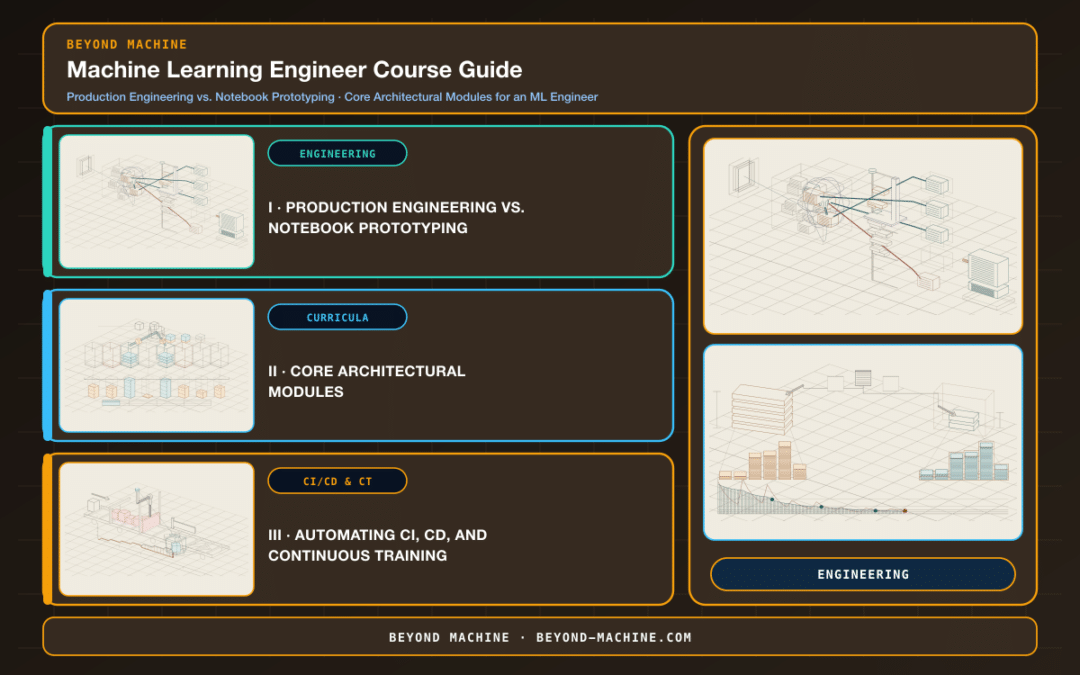
A comprehensive machine learning engineer course must address a fundamental shift in industry practice: moving beyond standalone model development to building, deploying, and maintaining production systems. While introductory data science training often centers on offline training scripts and exploratory notebooks, production engineering requires managing infrastructure, automated retraining pipelines, data quality verification, and operational debt. Prospective engineers and engineering leaders assessing a curriculum need to evaluate whether a program teaches end-to-end system architecture or merely isolated statistical modeling.
Research across major technology organizations underscores this operational reality. In their landmark study on Hidden Technical Debt in Machine Learning Systems, researchers led by D. Sculley highlighted that actual machine learning code forms only an extremely small fraction of a real-world predictive system, surrounded by vast components for configuration, data collection, resource management, verification, and monitoring. Consequently, any serious course preparing students for an engineering career must prioritize operational practices, integration architectures, and systems-level risk management.
Production Engineering vs. Notebook Prototyping
Early-stage data science coursework typically focuses on training a predictive model on a fixed, static holdout dataset. In commercial production, however, this represents what Google Cloud’s operational guidance classifies as MLOps Level 0: an entirely manual, script-driven workflow characterized by interactive notebooks and a disconnected handoff between data scientists and operations engineers. As detailed in the Google Cloud documentation on MLOps continuous delivery and automation pipelines, manual handoffs of static model artifacts frequently cause training-serving skew and slow down delivery velocity.
A rigorous machine learning engineer course shifts focus toward building the surrounding infrastructure that supports continuous operations. While mastering foundational syntax is necessary across standard programming languages for machine learning and data analytics, an engineering role requires structuring reproducible environments, managing dependencies, and establishing continuous integration for data and schemas alongside source code. For practitioners deciding between formal academic programs—such as a master’s in machine learning—and applied engineering bootcamps, the deciding factor often rests on whether the syllabus covers live system operations or stops at offline mathematical modeling.
In a large-scale empirical study at Microsoft, published by Amershi et al. at the 2019 International Conference on Software Engineering (ICSE), researchers examined how engineering teams adapt to artificial intelligence across applications ranging from search and translation to fraud detection and security monitoring. Their findings showed that as data science capabilities scale up, roles bifurcate from generalist modelers into domain experts, model builders, and specialized platform builders who engineer cloud-based infrastructure. A modern training program must prepare students for these platform-oriented engineering demands.
Core Architectural Modules for an ML Engineer Curriculum
To prepare candidates for production systems, a machine learning engineer course must organize its curriculum around the complete machine learning lifecycle. According to Google Cloud’s continuous delivery framework, this lifecycle comprises several sequential and iterative stages:
- Data Extraction and Ingestion: Integrating diverse operational data sources, enforcing schemas, and ensuring scalable data retrieval.
- Exploratory Data Analysis and Preparation: Implementing feature transformations, cleaning pipelines, and rigorous dataset splitting (training, validation, and holdout test sets) to prevent data leakage. Students frequently rely on reference cheatsheets during initial training, but production curricula require translating exploratory scripts into containerized pipeline steps.
- Model Training and Hyperparameter Tuning: Executing distributed training jobs across hardware accelerators while tracking metadata, experiments, and artifact lineage.
- Evaluation and Validation: Establishing strict evaluation gates where candidate models are verified against production baselines and sliced performance metrics prior to deployment.
- Model Serving: Deploying validated models across various operational topologies, such as low-latency microservices with REST APIs, embedded edge runtimes, or high-throughput batch prediction engines.
- Continuous Monitoring: Tracking prediction bias, data drift, concept drift, and system health metrics to trigger automated alerts or rollback routines.
Students looking at advanced degree pathways, such as those covered in our analysis of Masters in Machine Learning UK: Academic Structure, Admissions, Costs, and Career Pathways, will find that academic programs emphasize theoretical foundations, whereas dedicated engineering courses emphasize pipeline automation, distributed execution, and operational architecture.
Automating CI, CD, and Continuous Training (CT)
Traditional software engineering relies on continuous integration (CI) and continuous delivery (CD) to test source code and deploy software packages. However, as articulated in Google Cloud’s MLOps framework, an effective machine learning engineering curriculum must extend these paradigms to accommodate the empirical and data-dependent nature of machine learning by introducing Continuous Training (CT):
- Continuous Integration (CI): CI extends beyond compiling code and running unit tests. In an ML system, CI pipelines must validate incoming data schemas, verify data distributions, test feature engineering logic, and run integration tests on pipeline components.
- Continuous Delivery (CD): Rather than merely deploying a compiled model binary or trained weights file, CD in MLOps automates the release of the multi-step ML training pipeline itself. This pipeline automatically deploys and manages the model prediction service once execution criteria are verified.
- Continuous Training (CT): A unique capability of mature ML systems where pipeline triggers automatically re-execute training, validation, and serving routines when incoming operational data drifts or performance thresholds degrade.
Curricula that omit CI/CD/CT leave engineers unprepared for production environments. Understanding these automated stages ensures that engineers can mitigate performance decay caused by evolving data profiles without requiring manual, error-prone script execution.
Mitigating Technical Debt and System Entanglement
A defining characteristic of an advanced machine learning engineer course is direct instruction on system-level anti-patterns and technical debt. In their foundational NeurIPS paper, Sculley et al. identified key architectural traps that commonly undermine real-world predictive applications:
- The CACE Principle (Changing Anything Changes Everything): Machine learning models combine signals rather than isolating them into neat software boundaries. Modifying an input feature, hyperparameter, sampling threshold, or data selection criterion dynamically alters the weights, distributions, and importance of all other features across the system.
- Correction Cascades: When a base model \(m_a\) does not completely solve a related problem $A’$, teams frequently take the shortcut of training an auxiliary correction model \(m’_a\) that consumes the output of \(m_a\). This creates tight coupling; any future improvement to \(m_a\) can degrade downstream corrections, resulting in an architectural deadlock. Courses must teach alternative designs, such as multi-task formulations or distinct, uncoupled models.
- Undeclared Consumers: When model outputs are logged or exposed without access controls or strict service level agreements (SLAs), other internal systems consume the predictions silently. This creates hidden feedback loops and visibility debt, making it impossible to predict the blast radius of model updates.
- Data Dependency Debt: Unlike compiled code dependencies, data dependencies cannot be fully identified by standard compilers and linkers. Systems accumulate unstable dependencies when consuming upstream signals that change calibration without notice, or underutilized dependencies when bundled and legacy features provide negligible marginal gain at high maintenance complexity.
- Pipeline Jungles and Glue Code: Massive scrapers, manual joins, and glue code developed to stitch disparate packages together often account for over 95% of a mature system’s codebase, introducing dead experimental codepaths and configuration vulnerabilities.
Similarly, the Microsoft study by Amershi et al. highlighted that managing and versioning data is significantly more challenging than versioning code, requiring strict model provenance tagging, combo-flighting across model updates, and defensive system design to prevent component entanglement from causing non-monotonic errors.
Curriculum Comparison: Modeling vs. Production Engineering
When selecting or designing a machine learning engineer course, evaluating structural differences between traditional, modeling-centric syllabi and production-grade engineering syllabi is critical. The following table contrasts these two instructional approaches based on established industry practices documented in Google Cloud architecture guidelines and empirical engineering studies:
| Curriculum Dimension | Traditional Modeling Course | Production Machine Learning Engineer Course |
|---|---|---|
| Primary Deliverable | Trained model weights or serialized files produced in a notebook | Automated, version-controlled pipeline executing CI, CD, and Continuous Training (CT) |
| Testing and Validation | Offline accuracy metrics (e.g., AUC-ROC, F1 score) on static holdout sets | Data schema validation, model validation against baselines, and live prediction bias monitoring |
| System Architecture | Standalone algorithm execution using local environments | Integrated pipelines incorporating data ingestion, feature stores, registries, and serving infrastructure |
| Operational Debt Management | Rarely addressed; focus remains on algorithmic iteration | Strategies to counter CACE effects, eliminate correction cascades, manage configuration, and audit data dependencies |
| Deployment Scope | Manual export to object storage or basic static API endpoint | Scalable serving infrastructure (REST microservices, batch processing, or edge) with automated rollback |
| Data Governance | Static CSV or database extracts without provenance tracking | Data versioning, provenance metadata tracking, and dependency analysis to prevent training-serving skew |
Actionable Evaluation Checklist for Machine Learning Courses
Prospective students and engineering managers vetting a course can use this source-backed checklist to ensure the training aligns with production realities documented across Google Cloud ML applications and operations architecture guides:
- Automated Pipeline Orchestration: Does the coursework require building reproducible pipelines that run data ingestion, training, and validation automatically, rather than running manual cells in a Jupyter notebook?
- Data and Schema Validation: Does the curriculum teach automated checks on input data types, missing values, and distribution shifts before training begins?
- Pipeline Deployment vs. Model Handoff: Are students taught how to package and deploy the automated training pipeline itself (MLOps Level 1/2) rather than merely uploading static pickle files?
- Model Evaluation Baselines: Does the course require comparing new candidate models against existing production baselines using domain-specific metrics and slice-based analysis?
- Serving Architectures: Does the syllabus cover multiple deployment patterns, including REST APIs for low-latency online serving, batch scoring systems, and deployment considerations for specialized hardware?
- Monitoring and Drift Detection: Are students instructed on instrumenting monitoring for live prediction bias, tracking input data changes, and configuring automated retraining alerts?
- Systemic Debt Mitigation: Does the curriculum provide actionable methods to identify and eliminate glue code, configuration errors, and unstable upstream data dependencies?
Frequently Asked Questions
What is the primary difference between a data science course and a machine learning engineer course?
A data science course primarily emphasizes exploratory data analysis, statistics, feature selection, and model training on static datasets. A machine learning engineer course focuses on production software engineering: designing automated data pipelines, continuous integration and delivery (CI/CD), continuous training (CT), serving infrastructure, and real-time monitoring to prevent system degradation and technical debt.
Why is continuous training (CT) important in machine learning engineering?
Unlike conventional software systems, which fail primarily due to coding bugs, machine learning models degrade when the statistical profile of incoming real-world data changes. Continuous training automates data extraction, model retraining, and validation in production, ensuring predictive systems maintain accuracy without manual developer intervention.
How does the CACE principle affect machine learning system design?
The CACE principle (“Changing Anything Changes Everything”), identified by Sculley et al., describes the entangled nature of machine learning models. Modifying a single feature, tuning parameter, or data source alters how the model utilizes all other signals. Production courses teach engineers to detect these shifts using slice-based evaluation, feature management, and defensive data dependency analysis.
References
- Hidden Technical Debt in Machine Learning Systems
- MLOps: Continuous delivery and automation pipelines in machine learning | Cloud Architecture Center | Google Cloud Documentation
- ML applications and operations architecture guides | Cloud Architecture Center | Google Cloud Documentation
1-on-1 AI & Data Science Mentorship
Accelerate your career with personal coaching from Dr. Stylianos Kampakis. Tailored portfolio reviews, interview prep, and direct industry placement.
Bespoke Mathematical Tokenomics Design & Simulation
cadCAD differential equations and token velocity modeling to design antifragile, sustainable cryptoeconomies.